

Mother-of-Pearl Jewelry Box: Paired Cranes in a Pine Grove
- Worldwide Shipping
- Low stock - 1 item left
- Backordered, shipping soon
This piece is chosen by those who understand that an intimate object can hold a complete symbolic landscape without losing its purpose in everyday life.
”The surface catches the room in fragments of colour, while within the grove two cranes remain quietly turned towards one another.“
The most compelling aspect of this Korean jewellery box is the way its imagery has been organised in layers of attention. The shellwork is abundant, yet the composition is not indiscriminate. A clear hierarchy governs the object: first the crane-and-pine landscape on the lid, then the surrounding flowers and vines, then the architectural borders, and finally the concealed interior. Looking at the box therefore becomes a movement from image to ornament, from ornament to structure, and from structure to private use.
The lid forms the symbolic centre. Its oval field operates almost like a picture within the object, isolating a pair of cranes among pine trees and a dense flowering grove. The cranes are positioned in relation to one another rather than as independent emblems. Their opened wings and opposing directions give movement to the composition, yet their mutual orientation keeps that movement contained within the scene.
This arrangement carries particular resonance in a Korean context. Cranes are enduring symbols of longevity, refinement and auspicious life; the pine, evergreen through winter, is associated with constancy, resilience and longevity. Their combination therefore allows the image to speak simultaneously of duration and relationship. The landscape is not merely a background for the birds. It gives the cranes a world in which their symbolic meaning can take form.
The maker has surrounded this central scene with a more continuous ornamental language of peonies, butterflies and dangcho vines. These motifs do not behave like the landscape above. Instead, they spread across corners, sides and borders, moving without a fixed beginning or end. The peony contributes associations of prosperity, dignity and abundance, while the scrolling vine suggests sustained vitality and continuation. Butterflies introduce a lighter, more fleeting presence, softening the formal density of the box.
This difference between the central scene and the surrounding ornament is deliberate. The cranes ask to be looked at as figures within a place; the floral and vine patterns ask to be followed as rhythm. One is pictorial, the other continuous. Together they allow the box to be viewed both as image and as object.
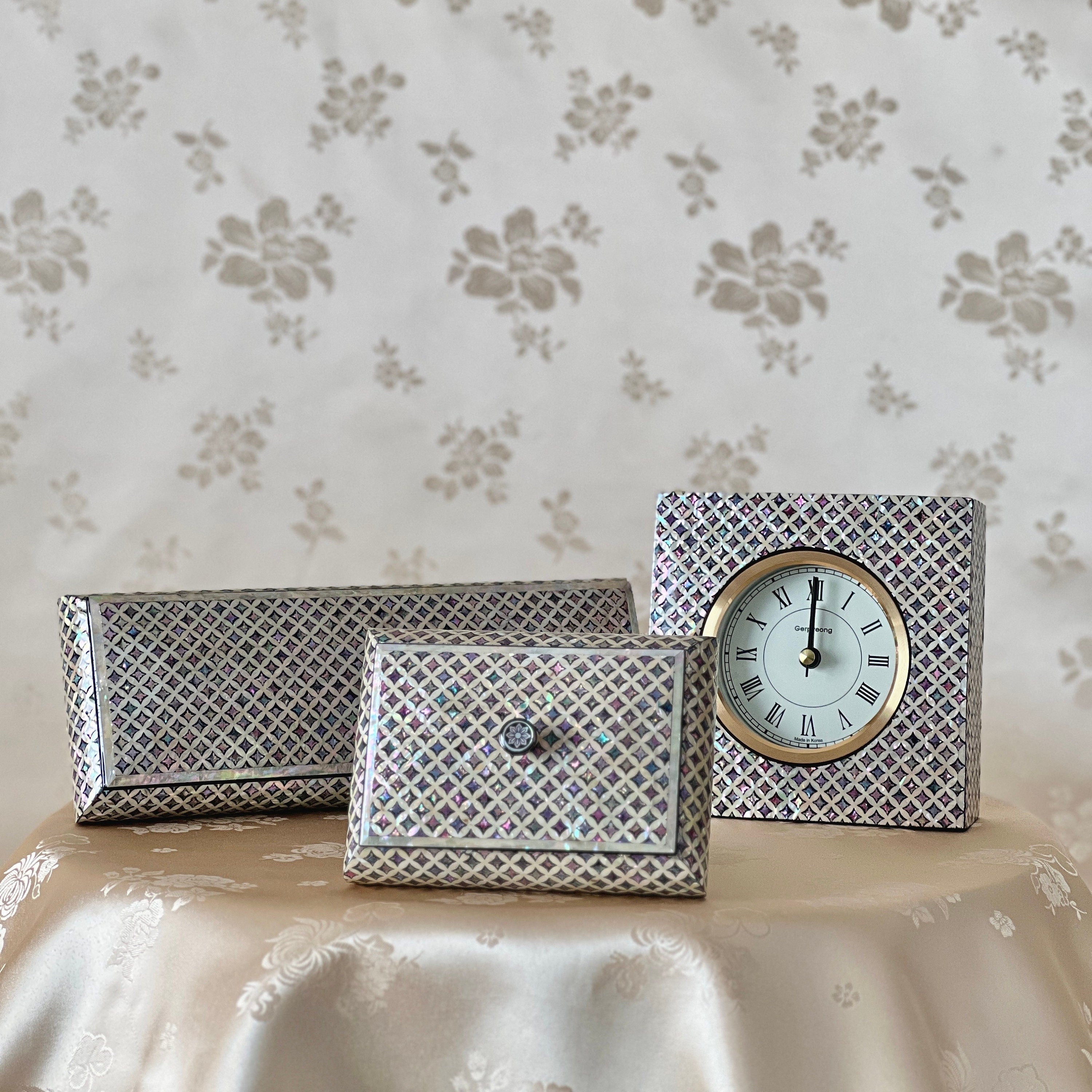
Material is essential to this distinction. Thin shell pieces have been cut and shaped so that each form emerges against a contrasting shell ground. Different shell tones are placed beside one another to sharpen the separation between bird, flower, branch and surrounding field. Pale shell may read almost silver from one angle, then turn green, violet or rose as the light shifts. Darker pieces behave differently, absorbing more of the surrounding colour before suddenly flashing.
For this reason, the box has no completely stable appearance.
Morning light, artificial light and a low evening reflection will not reveal the same arrangement of colour. The physical motif remains unchanged, yet the shell continuously rearranges its visual emphasis. A flower that appears subdued in one moment may become the brightest point of the surface in another. The object therefore resists a single fixed view; its material makes repeated looking part of its meaning.
The geometry around the lid performs an equally important role. The angular repeating border provides an architectural frame for the more fluid organic motifs within. Without it, the floral abundance could visually disperse beyond the limits of the object. The border gathers the composition, establishing a disciplined edge between the imagined landscape and the physical box.
That distinction becomes more pronounced when the clasp is opened.
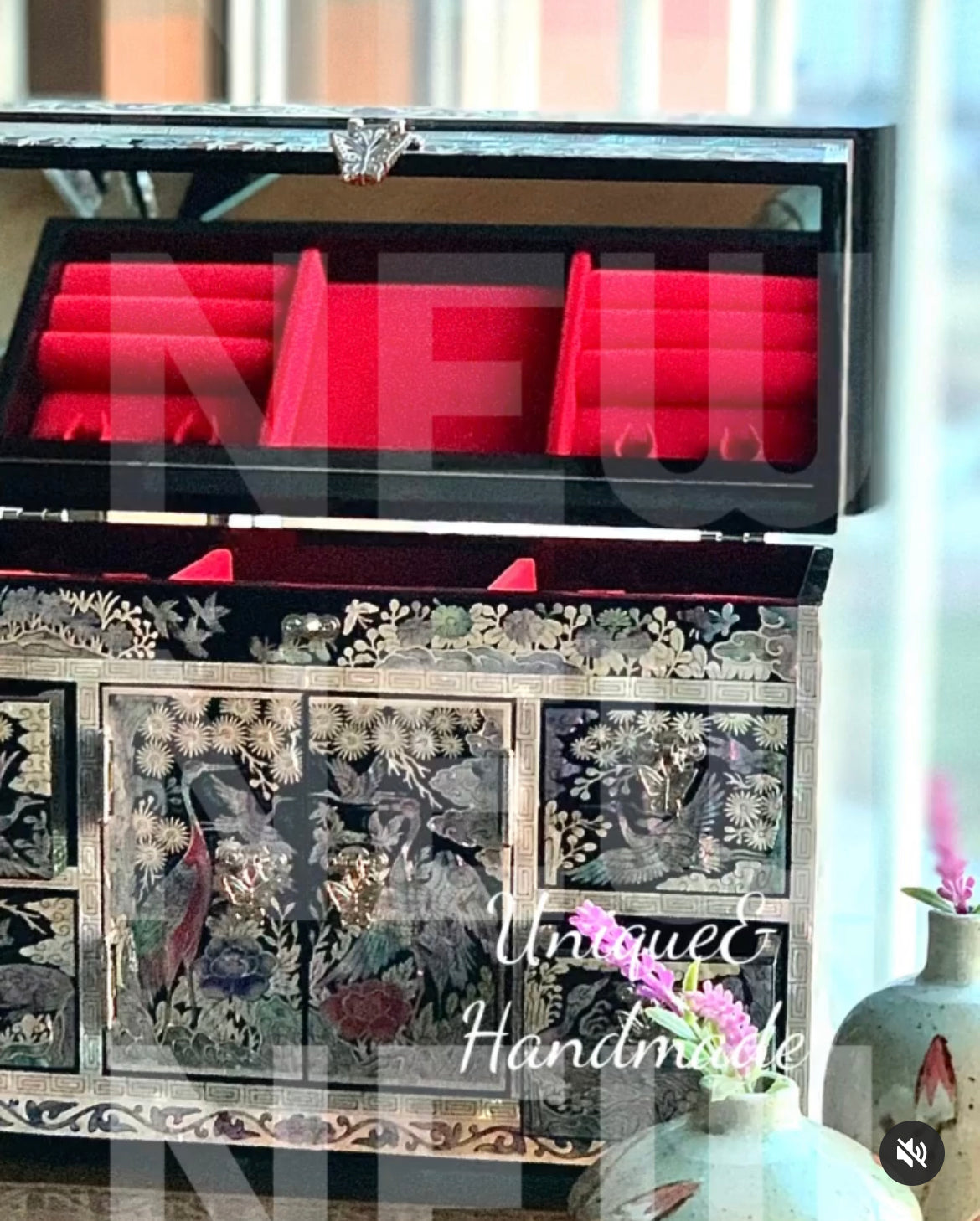
The exterior has prepared the eye for brightness, density and continual movement. Inside, the atmosphere becomes quieter. The mirror introduces the viewer directly into the object, while the rose-toned textile lining softens the hard brilliance of the shell. The removable tray divides the interior into smaller spaces, including cushioned sections for rings and other small jewellery. Use is therefore organised by scale and intimacy.
Lifting the tray creates a second act of discovery. A deeper storage space is revealed, and shellwork reappears inside the lower chamber. This is significant because the most elaborate material does not belong exclusively to the surface shown to others. It continues into a space ordinarily concealed when the box is closed.
The object consequently moves through three states. Closed, it is a luminous landscape. Opened, it becomes a place of reflection and ordered safekeeping. With the tray removed, it reveals a deeper interior whose shellwork is encountered only through handling.
Its richness lies in this sequence.
The cranes and pine speak of longevity and constancy; the peonies, butterflies and vines extend the language towards abundance, vitality and continuing life. Yet these symbols are not simply accumulated upon the surface. They have been organised around the ritual of keeping: opening, selecting, placing, protecting and returning something valued to its appointed place.
The box therefore feels most complete not when seen from a single angle, but when slowly handled. Light moves across its shell, the landscape gives way to the mirror, the upper tray rises, and another luminous surface appears below. It is in this gradual unfolding that the object moves beyond ornament and becomes a small architecture of memory and care.
Dimensions
- Width- 23.7cm (9.33 inch)
- Depth- 15.7cm (6.18 inch)
- Height- 9.5cm (3.74 inch)
Related Links
We ship worldwide. Following are the terms and conditions that constitute our Shipping Policy.
Artinko Products: Care and Authenticity
All information supplied through the Site is for informational purposes regarding the history and care of traditional Korean crafts. While we guarantee 100% authentic materials, Artinko is not responsible for damage caused by improper handling, such as using non-food-safe decorative items for dining or using harsh chemicals on delicate Mother-of-Pearl surfaces.
Section 13: Our Delivery Guarantee
Unlike standard templates, Artinko takes full responsibility for your order until it is safely in your hands. We understand the fragile nature of traditional Korean ceramics and lacquerware. In the rare event that an item is damaged or lost during transit, we will resend the item at no extra cost to you or issue a full refund immediately upon verification of the damage.
Returns & Refunds
-
14-Day Return Policy: Merchandise can be returned or exchanged within 14 days of receipt if the product has not been opened or used and remains in its original packaging.
-
Process: To start a return or report a shipping issue, please contact us at contact@artinko.com.
-
Exchanges: We only replace items if they are defective or damaged.
Shipment processing time
- All orders are aimed to be processed within 5 days after receipt of payment. Orders are not shipped on weekends and holidays.
- If we are experiencing a high volume of orders, shipments may be delayed by a few days. We will contact you by email if there is some delay in shipment of your order.
Shipping rates and delivery estimates
- All orders are shipped by K-Packet, Air mail, EMS, Express Courier (UPS, Fedex, DHL Etc).
- K-Packet shipping is basic shipping service. K-Packet estimated shipping time is 14-21 days, depending on your region. If weight is over 2kg, K-packet service would be converted to Air Mail.
- EMS estimated shipping time is 7-14 days, depending on your region. Please note that Air Mail shipping method may not be available for all countries.
- Express Courier estimated shipping time is 5-10 days.
- Shipping charges for your order will be calculated and displayed at checkout.
- Parcels are sent tracked where possible, and you will receive an automated email with a tracking number once your order is processed.
Shipment to P.O. boxes
- We do ship to P.O. boxes
Shipment confirmation and Order tracking
- You will receive a shipment confirmation email with a tracking number once your order has been shipped.
Damages
- We pack our items with extreme care to ensure they survive the journey. In the rare event of damage, contact us immediately with a photo and we will work with you to find a solution.
Customs duty
- Please note that your parcel may be subjected to the customs of your country when it arrived in. And the customs duty is the recipient’s responsibility. USA customers only: we pay your customs fee!
- Please note we have no control over these fees. Delivery time may also be delayed if local customs have your package on hold for a long period of time.
If you have problems with delivery, please send us an email to contact@artinko.com