This piece is chosen by those who respond to restraint even in richness, and who recognise that symbolic objects are meant to be lived with slowly.
“Across the dark surface, splendour is gathered into stillness rather than display.”
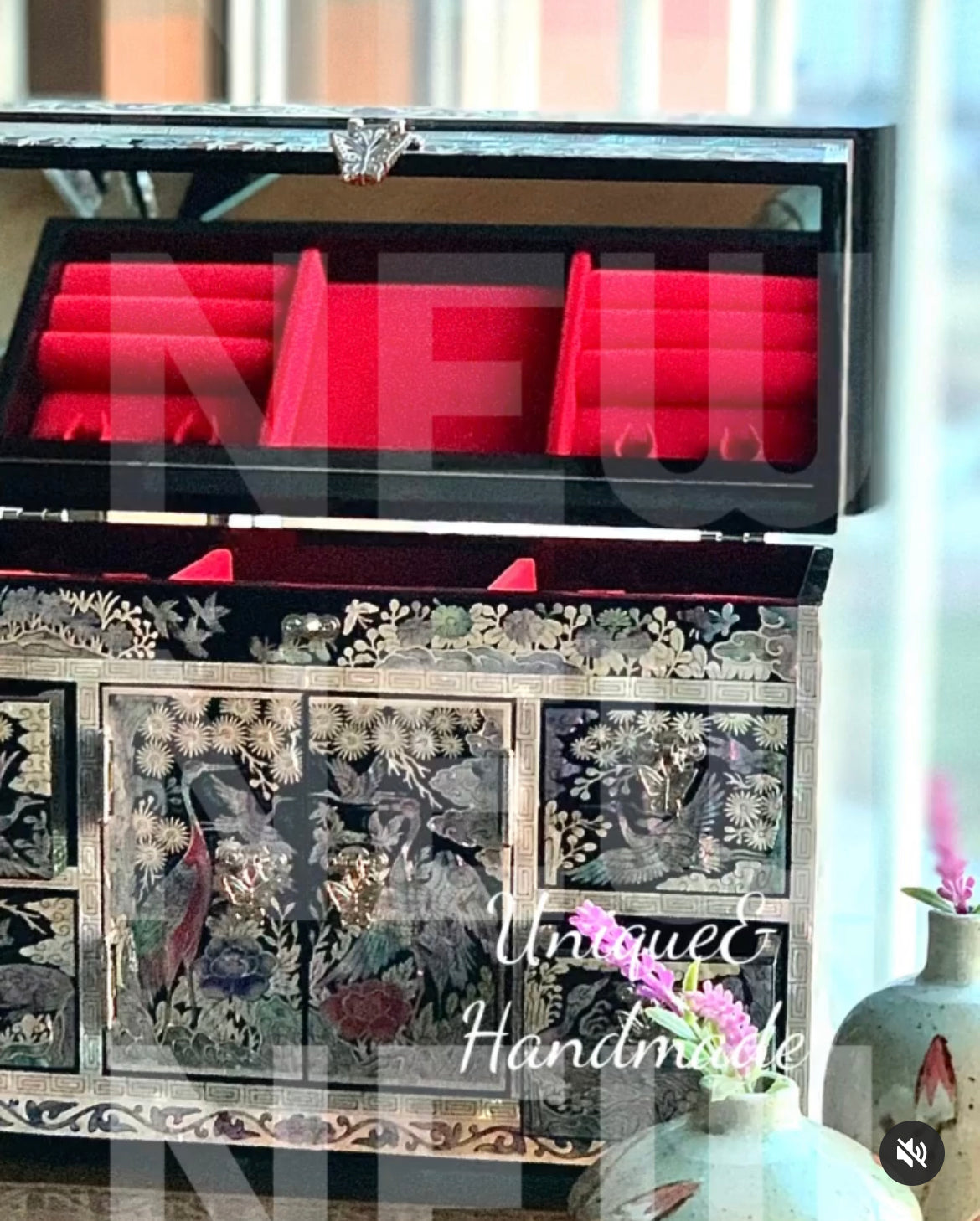
At first glance, this double-doored jewellery chest appears to be governed by the peacock alone. The front composition gives that impression deliberately: the bird occupies the central field with full authority, surrounded by large peonies and enclosed within a disciplined framework of geometric borders and scrolling ornament. Yet the chest has not been conceived as a single-image object. Its iconography expands as one moves around it. The peacock establishes the tone of nobility and cultivated beauty, but the lower drawer, side panels, and reverse open that tone into a wider symbolic landscape associated with Korean longevity imagery. In this sense, the chest is built not around one emblem, but around a hierarchy of meanings.
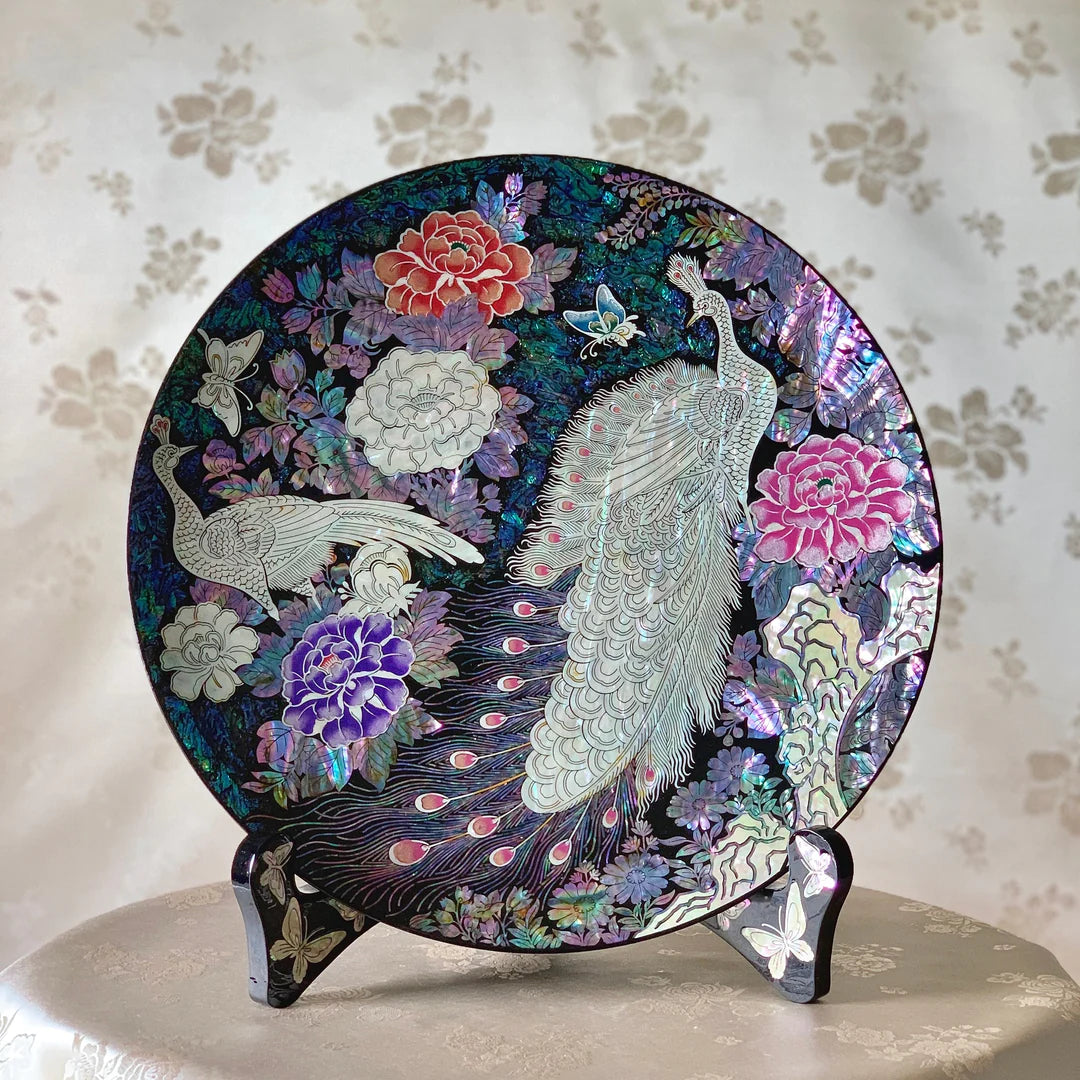
The front doors are composed with notable control. The peacock is not placed frontally or symmetrically. Instead, its body turns across the seam of the doors, while the long tail descends diagonally, binding the two panels into one continuous image. This is important structurally. A double-door format always risks becoming visually divided, yet here the bird’s form overcomes that division and turns the opening line of the object into part of the composition itself. The doors do not interrupt the image; they hold it in suspension. Around the bird, peonies gather in varying scale and colour, creating a field of abundance that remains ordered rather than diffuse. In Korean visual culture, peonies signify honour, prosperity, and fullness, while the peacock introduces grace, dignity, and ceremonial presence. The chest was made in this way so that the frontal image would declare the object’s status with clarity, but without aggression.
Below this principal scene, the lower drawer offers a deliberate shift in mood. Here, cranes and deer appear in a horizontal reserve, quieter in scale and more landscape-like in feeling. This band introduces imagery that recalls the 십장생 tradition, in which cranes and deer belong to a broader symbolic wish for longevity, peace, and enduring continuity. Their placement beneath the peacock is not incidental. It grounds the brilliance above in something steadier and more lasting. One might say that the upper register speaks of cultivated splendour, while the lower register speaks of life extended through harmony with the natural order. This vertical relationship gives the chest unusual symbolic depth: prestige is present, but it is anchored by blessing.
The side panels deepen this reading further. Their tall, narrow reserves are well suited to deer and cranes moving through vegetal growth beneath a moonlit or atmospheric upper field. These are not merely decorative continuations. They act almost as lateral chapters to the main façade, enlarging the object’s world. Because the side imagery is more secluded and elongated, it introduces a slower rhythm of viewing. One does not receive it all at once. The chest asks to be circled. In doing so, it reveals that its symbolic life extends beyond frontal display into an environment of continuity, seasonality, and quiet endurance. The reverse panel, with cranes flying under moon and cloud forms, completes this circuit with notable economy. The imagery is sparse compared to the front, yet that spareness is eloquent. It allows the object to exhale.
Materially, the black ground is what holds these varied motifs together. Against it, the applied shellwork acquires both brilliance and depth. Pale green, violet, silver, blue, and rose reflections rise and recede with the changing light, but because the ground is dark, the luminosity never becomes diffuse. It is concentrated. This is crucial to the emotional tone of the piece. A lighter ground would have opened the imagery outward; here, the darker field gathers it inward, giving the chest a more contemplative authority. The border systems reinforce this. Key-pattern framing, scrolling vines, and floral margins do not simply embellish the surfaces. They regulate them. They create interval, boundary, and repose, ensuring that each symbolic scene is given a clear place within the whole.
The top surface and overall scale also matter. This is not a minor chest made to disappear into use. Its broader proportions and crowned upper edge give it a small architectural presence. Even the upper plane is treated as part of the object’s symbolic field, extending the peacock-and-flower imagery beyond the front and preventing the chest from having a merely functional top. The result is that the object feels complete from above as well as from the sides and front. It carries its imagery like a skin of meaning rather than a single decorated face.
When the doors are opened, the chest changes register decisively. Outside, the imagery is public, symbolic, and ceremonially composed. Inside, the structure becomes intimate and practical. Three drawers appear on the left, each retaining floral shellwork so that the decorative language continues inward rather than stopping at the threshold. On the right, a mirrored compartment with hanging fixtures receives necklaces and longer ornaments, while below, a red-lined ring section introduces a note of softness and warmth. The mirror is especially important. It is not merely functional. It activates the interior by doubling light and movement, so that the act of opening becomes a visual transition from dark exterior depth to reflective interior space. The chest thus moves from emblem to ritual: from being looked at, to being used with attentiveness.
This relation between closed and opened states is where the object becomes most fully itself. Closed, it presents a peacock world of nobility, peony abundance, and measured radiance. Opened, it reveals order, reflection, and containment. Around its sides and base, cranes and deer quietly extend the meaning towards longevity, constancy, and auspicious continuance. The chest was made in this way so that its symbolism would not be exhausted by a single glance. It unfolds through movement, through turning, through opening, and through repeated use. For that reason, it feels less like a jewellery container than a small inhabited structure: one that holds adornment within a larger atmosphere of endurance, grace, and composed blessing.
Dimensions
- Height- 30cm (11.81 inch)
- Width- 24cm (9.45 inch)
- Depth- 15cm (5.91 inch)
Related Links