

Celadon Jar: Incised Mugunghwa (Rose of Sharon) Motif, 2009
- Worldwide Shipping
- Low stock - 1 item left
- Backordered, shipping soon
Those who choose this piece tend to appreciate objects in which cultural meaning is carried through patient workmanship rather than elaborate display.
"Across the rounded celadon surface, the mugunghwa blossoms continue without beginning or end."
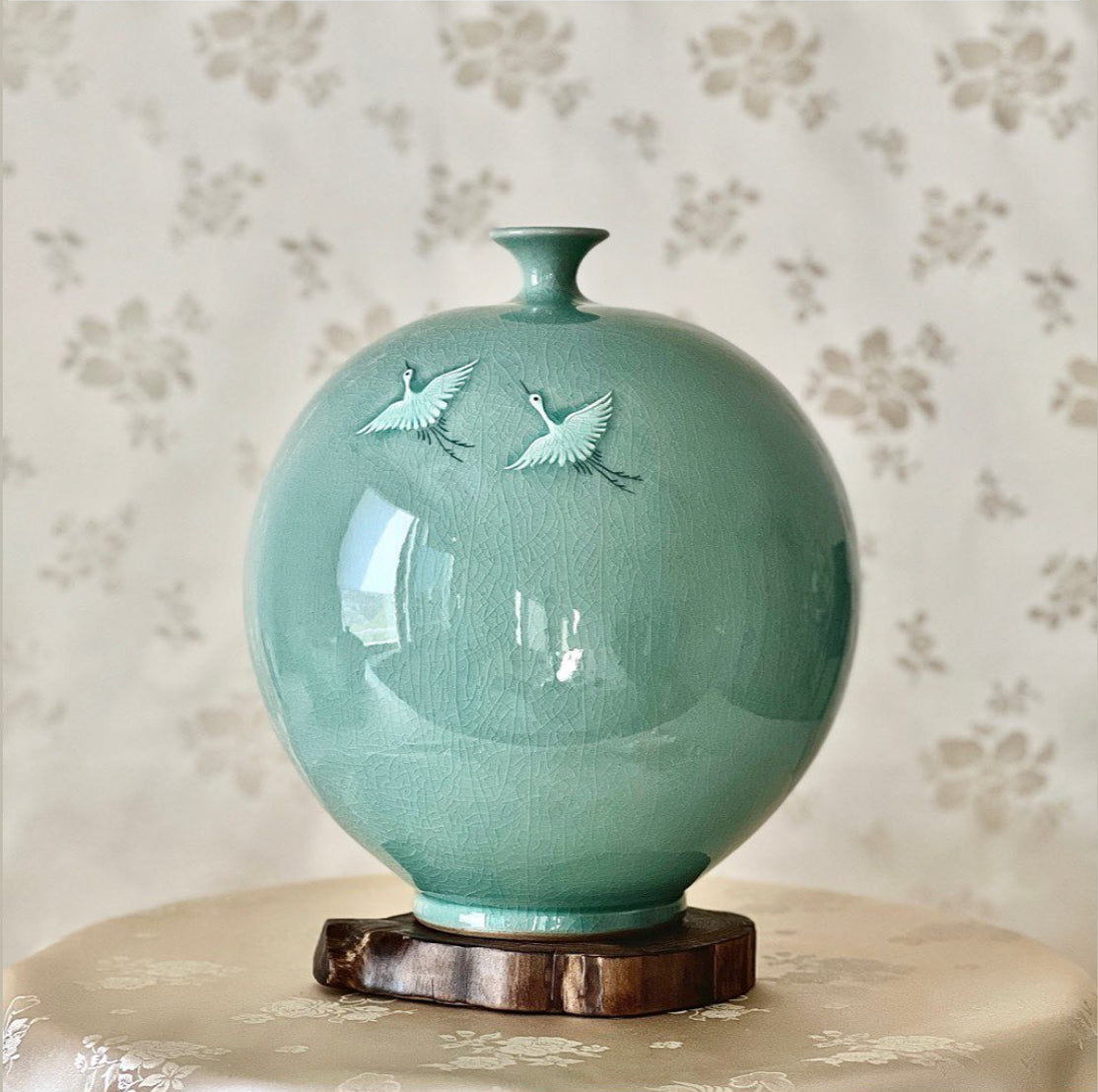
Kim Yong Seop's Korean Celadon Jar: Incised Mugunghwa Motif, made in 2009, brings one of Korea's most familiar national symbols into a carefully controlled ceramic composition. The entire body is covered with engraved mugunghwa blossoms, each maintained at a remarkably consistent scale. Their repetition gives the jar its distinctive character, although the shape beneath them deserves equal attention.
The vessel rises from a relatively narrow foot into a broad, rounded body. Its fullness is concentrated around the middle and upper sections, where the curve gradually turns inward towards the opening. There is a natural generosity to this form, but little sense of excess. The proportions remain carefully contained within a simple, almost spherical silhouette.
The mouth is an especially interesting detail.
Traditional jars often have a clearly defined neck or a substantial rim that separates the body from the opening. Kim has chosen a different approach. Here, the mouth is exceptionally low, with almost no projecting lip to interrupt the rounded shoulder.
This gives the upper part of the vessel an unusual continuity. The eye follows the curve naturally towards the opening, without encountering the pronounced change of direction that a thicker rim would create.
Such simplicity is not necessarily easier to achieve. A more prominent rim can provide a clear structural and visual conclusion to a ceramic form. With that feature reduced to a minimum, the transition between shoulder and opening must be resolved with particular care. Even a small irregularity would become apparent against the otherwise uninterrupted curve.
Kim's decision gives the jar a character that feels both traditional and unusually restrained.
The surface, by contrast, is densely worked.
Mugunghwa blossoms cover the vessel in closely arranged groups, their petals defined by fine incised lines. The flowers are similar in scale, yet their placement follows the rounded body rather than a rigid rectangular grid. As the curvature changes, the pattern adjusts with it, remaining continuous across the expanding and narrowing surface.
This consistency is one of the most demanding aspects of the work.
An individual flower can be drawn with relative freedom. Repeating that flower across an entire ceramic body, while keeping its proportions and spacing under control, requires a different kind of discipline. The artisan must consider each blossom in relation to those already completed and those still to come.
There is little room for an isolated gesture. Every line contributes to the larger pattern.
What is striking is that the repetition never entirely loses its handmade character. The flowers remain recognisably related, but small variations in their outlines and surrounding leaves give the surface a natural rhythm. The eye moves from one blossom to the next, gradually recognising the patience involved in sustaining such a composition.
The choice of mugunghwa gives this disciplined arrangement a particular cultural resonance.
As the national flower of South Korea, the mugunghwa has long been associated with perseverance, resilience and the enduring spirit of the Korean people. Its name evokes the idea of continuity, while its capacity to produce blossoms over an extended flowering season has made it a fitting emblem of persistence.
In this vessel, that meaning is not conveyed through a single, prominently displayed flower. Instead, the blossoms are repeated across the entire body.
The symbolism becomes inseparable from the manner of execution.
Each flower occupies its own small area, but none is treated as the central subject. Together, they create a continuous flowering surface. The repetition suggests endurance, while the consistency of the engraving gives that idea a visible expression of patience and care.
It is an interpretation that arises naturally from the work itself. The cultural meaning of the mugunghwa and the discipline required to repeat it become closely connected.
The celadon glaze brings these elements together.
Its pale blue-green colour settles over the engraved flowers, softening their outlines without concealing the detail. The incisions remain visible as fine variations across the surface, particularly where light catches the rounded body at an angle.
There is no strong colour contrast to separate the flowers from the vessel. Instead, the motif belongs entirely to the ceramic surface. At a distance, the jar reads as a single rounded form with a delicate overall texture. Closer inspection reveals individual blossoms, leaves and the measured lines that define them.
This change in perception is part of the pleasure of looking.
From a distance, the silhouette comes first: a generous body, a narrow foot and an exceptionally restrained mouth. As one approaches, the floral pattern becomes increasingly apparent. The eye begins to follow the repeated blossoms, discovering the small decisions that give each its form.
The decoration does not end at a single privileged viewpoint. It continues around the body, encouraging the viewer to move alongside the vessel rather than consider it only from the front.
There is something particularly fitting about the relationship between the mugunghwa and this rounded shape. The vessel has no pronounced corners or abrupt changes in contour. The flowers can therefore continue across its surface with little interruption, their repeated forms following the natural movement of the clay.
Kim Yong Seop has brought together two demanding choices: a densely engraved composition whose individual elements remain carefully proportioned, and a ceramic silhouette whose simplicity leaves little room for visual correction.
Neither competes with the other.
The rounded body gives the flowers a continuous surface on which to unfold, while the engraving lends detail and human presence to an otherwise restrained form.
Made in 2009, the jar offers a thoughtful expression of Korean cultural identity through a familiar flower and an uncommon degree of patience. Its meaning is not confined to the national symbolism of the mugunghwa. It can also be found in the repeated act of making each blossom, one after another, until the entire vessel is covered.
The flowers are numerous, but none feels unnecessary. Their quiet persistence is what remains with the viewer.
Dimension
- Diameter- 47 cm (18.5 inch)
- Height- 45cm (17.72 inch)
Related Links
We ship worldwide. Following are the terms and conditions that constitute our Shipping Policy.
Artinko Products: Care and Authenticity
All information supplied through the Site is for informational purposes regarding the history and care of traditional Korean crafts. While we guarantee 100% authentic materials, Artinko is not responsible for damage caused by improper handling, such as using non-food-safe decorative items for dining or using harsh chemicals on delicate Mother-of-Pearl surfaces.
Section 13: Our Delivery Guarantee
Unlike standard templates, Artinko takes full responsibility for your order until it is safely in your hands. We understand the fragile nature of traditional Korean ceramics and lacquerware. In the rare event that an item is damaged or lost during transit, we will resend the item at no extra cost to you or issue a full refund immediately upon verification of the damage.
Returns & Refunds
-
14-Day Return Policy: Merchandise can be returned or exchanged within 14 days of receipt if the product has not been opened or used and remains in its original packaging.
-
Process: To start a return or report a shipping issue, please contact us at contact@artinko.com.
-
Exchanges: We only replace items if they are defective or damaged.
Shipment processing time
- All orders are aimed to be processed within 5 days after receipt of payment. Orders are not shipped on weekends and holidays.
- If we are experiencing a high volume of orders, shipments may be delayed by a few days. We will contact you by email if there is some delay in shipment of your order.
Shipping rates and delivery estimates
- All orders are shipped by K-Packet, Air mail, EMS, Express Courier (UPS, Fedex, DHL Etc).
- K-Packet shipping is basic shipping service. K-Packet estimated shipping time is 14-21 days, depending on your region. If weight is over 2kg, K-packet service would be converted to Air Mail.
- EMS estimated shipping time is 7-14 days, depending on your region. Please note that Air Mail shipping method may not be available for all countries.
- Express Courier estimated shipping time is 5-10 days.
- Shipping charges for your order will be calculated and displayed at checkout.
- Parcels are sent tracked where possible, and you will receive an automated email with a tracking number once your order is processed.
Shipment to P.O. boxes
- We do ship to P.O. boxes
Shipment confirmation and Order tracking
- You will receive a shipment confirmation email with a tracking number once your order has been shipped.
Damages
- We pack our items with extreme care to ensure they survive the journey. In the rare event of damage, contact us immediately with a photo and we will work with you to find a solution.
Customs duty
- Please note that your parcel may be subjected to the customs of your country when it arrived in. And the customs duty is the recipient’s responsibility. USA customers only: we pay your customs fee!
- Please note we have no control over these fees. Delivery time may also be delayed if local customs have your package on hold for a long period of time.
If you have problems with delivery, please send us an email to contact@artinko.com