

Schmuckschatulle aus Perlmutt: Kranichpaar im Kiefernwald
- Weltweiter Versand
- Geringer Lagerbestand – nur noch 1 Stück verfügbar
- Nachbestellt, bald verfügbar
Dieses Stück wurde von jenen ausgewählt, die verstehen, dass ein intimes Objekt eine vollständige symbolische Landschaft beherbergen kann, ohne seinen Zweck im Alltag zu verlieren.
„Die Oberfläche fängt den Raum in Farbfragmenten ein, während innerhalb des Hains zwei Kraniche ruhig einander zugewandt bleiben.“
Der faszinierendste Aspekt dieser koreanischen Schmuckschatulle ist die Art und Weise, wie ihre Bilder in Schichten der Aufmerksamkeit organisiert wurden. Die Perlmuttarbeit ist reichhaltig, doch die Komposition ist nicht wahllos. Eine klare Hierarchie bestimmt das Objekt: zuerst die Kranich-und-Kiefern-Landschaft auf dem Deckel, dann die umgebenden Blumen und Ranken, dann die architektonischen Ränder und schließlich das verborgene Innere. Das Betrachten der Schatulle wird somit zu einer Bewegung vom Bild zum Ornament, vom Ornament zur Struktur und von der Struktur zum privaten Gebrauch.
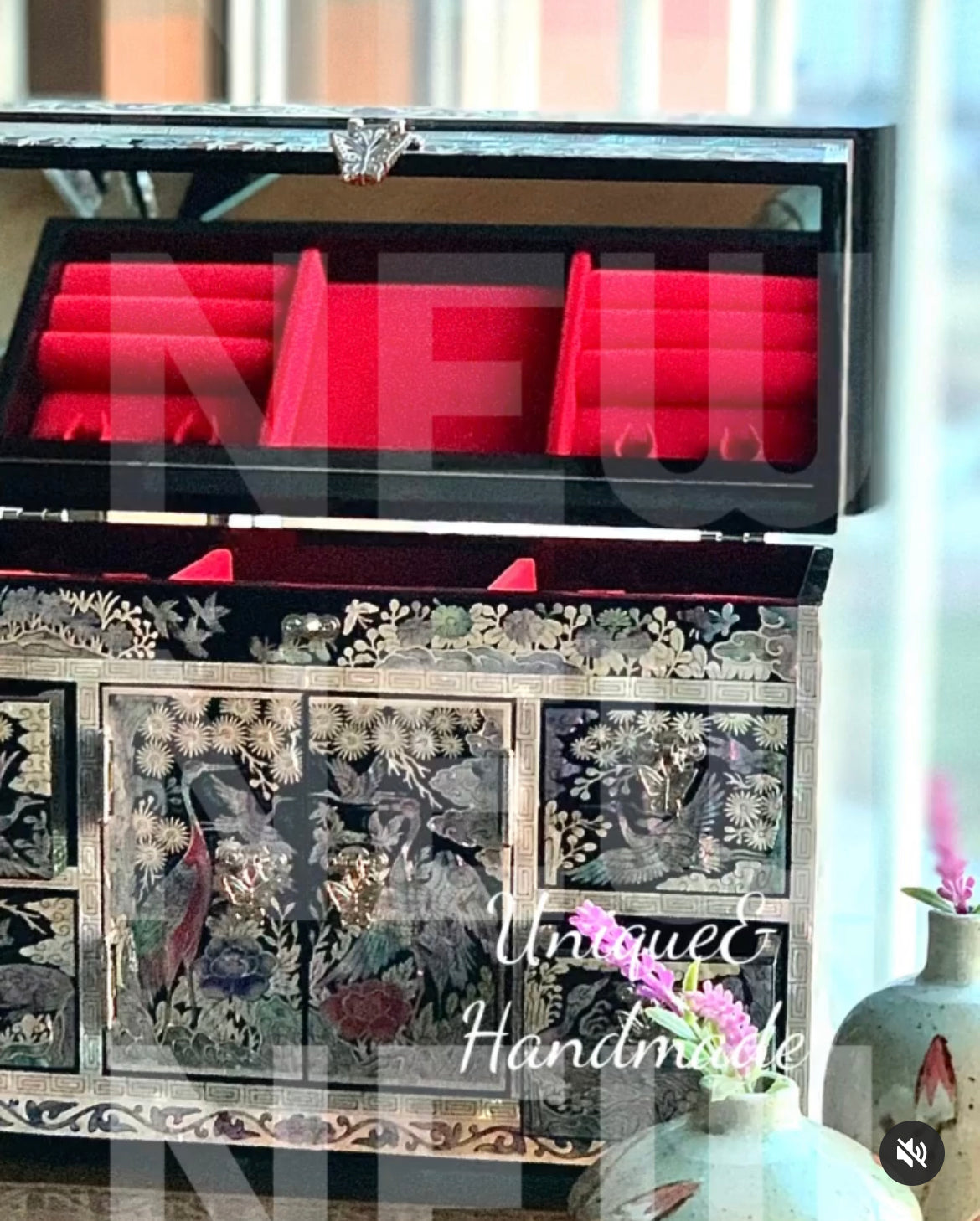
Der Deckel bildet das symbolische Zentrum. Sein ovales Feld wirkt fast wie ein Bild innerhalb des Objekts und isoliert ein Paar Kraniche zwischen Kiefern und einem dichten blühenden Hain. Die Kraniche sind zueinander positioniert, nicht als unabhängige Embleme. Ihre geöffneten Flügel und entgegengesetzten Richtungen verleihen der Komposition Bewegung, doch ihre gegenseitige Ausrichtung hält diese Bewegung innerhalb der Szene gefangen.
Diese Anordnung hat in einem koreanischen Kontext eine besondere Bedeutung. Kraniche sind dauerhafte Symbole für Langlebigkeit, Raffinesse und ein glückverheißendes Leben; die Kiefer, die den Winter über immergrün ist, wird mit Beständigkeit, Widerstandsfähigkeit und Langlebigkeit assoziiert. Ihre Kombination erlaubt es dem Bild daher, gleichzeitig von Dauer und Beziehung zu sprechen. Die Landschaft ist nicht bloß ein Hintergrund für die Vögel. Sie gibt den Kranichen eine Welt, in der ihre symbolische Bedeutung Gestalt annehmen kann.
Der Hersteller hat diese zentrale Szene mit einer durchgehenden Ornamentik aus Pfingstrosen, Schmetterlingen und Dangcho-Ranken umgeben. Diese Motive verhalten sich anders als die Landschaft darüber. Stattdessen breiten sie sich über Ecken, Seiten und Ränder aus und bewegen sich ohne festen Anfang oder Ende. Die Pfingstrose trägt Assoziationen von Wohlstand, Würde und Überfluss bei, während die rankende Ranke anhaltende Vitalität und Fortsetzung suggeriert. Schmetterlinge führen eine leichtere, flüchtigere Präsenz ein, die die formale Dichte der Schatulle mildert.
Dieser Unterschied zwischen der zentralen Szene und dem umgebenden Ornament ist beabsichtigt. Die Kraniche wollen als Figuren innerhalb eines Ortes betrachtet werden; die Blumen- und Rankenmuster wollen als Rhythmus verfolgt werden. Das eine ist bildlich, das andere durchgehend. Zusammen ermöglichen sie es, die Schatulle sowohl als Bild als auch als Objekt zu betrachten.
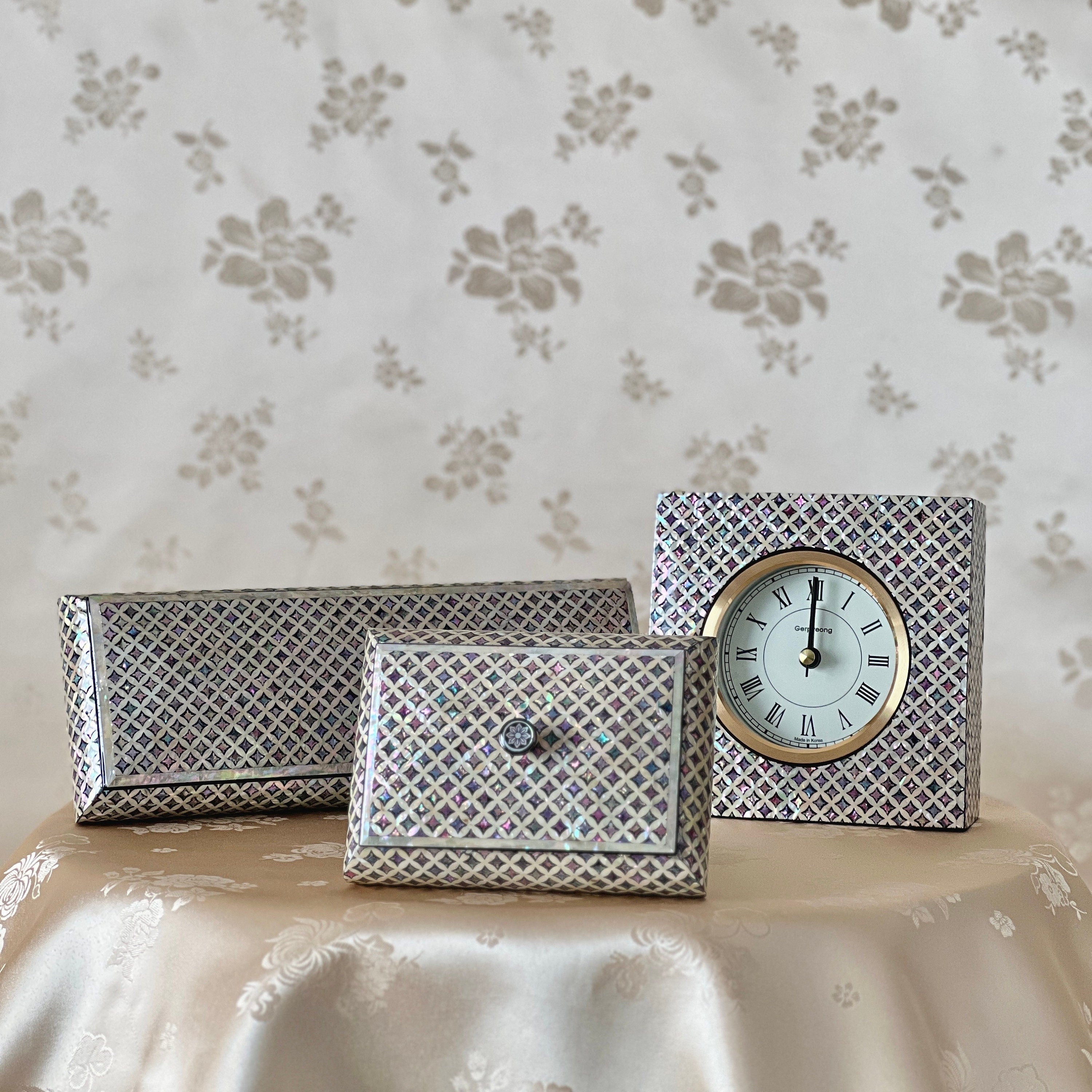
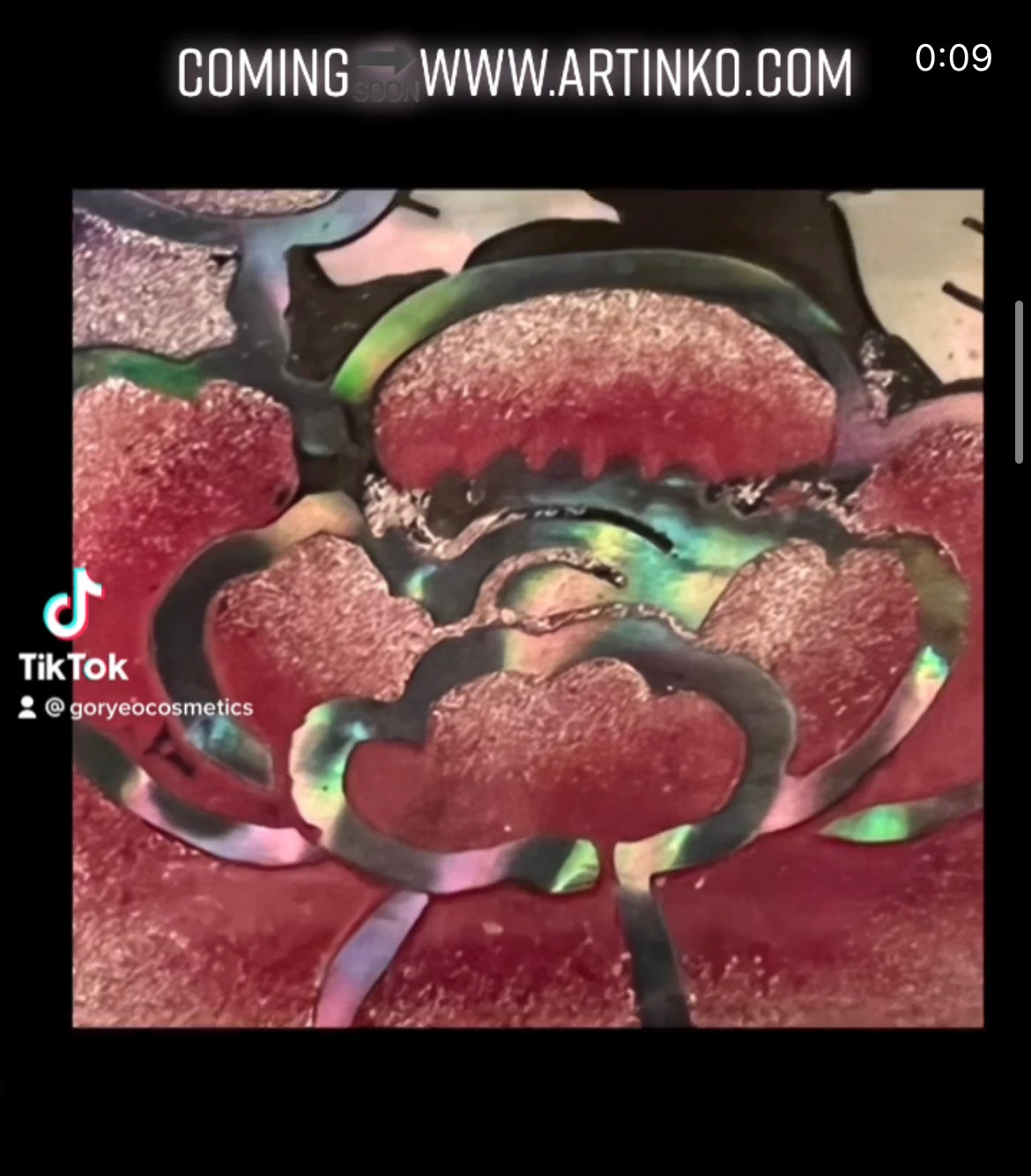
Material ist für diese Unterscheidung wesentlich. Dünne Perlmuttschalenstücke wurden geschnitten und geformt, sodass jede Form sich von einem kontrastierenden Perlmuttgrund abhebt. Verschiedene Perlmuttfarbtöne werden nebeneinander platziert, um die Trennung zwischen Vogel, Blume, Ast und dem umgebenden Feld zu schärfen. Helles Perlmutt kann aus einem Winkel fast silbern wirken und dann grün, violett oder rosafarben werden, wenn sich das Licht ändert. Dunklere Stücke verhalten sich anders, absorbieren mehr von der umgebenden Farbe, bevor sie plötzlich aufleuchten.
Aus diesem Grund hat die Schatulle kein völlig stabiles Aussehen.
Morgenlicht, künstliches Licht und eine schwache Abendreflexion werden nicht dieselbe Farbanordnung zeigen. Das physische Motiv bleibt unverändert, doch das Perlmutt ordnet seinen visuellen Schwerpunkt kontinuierlich neu an. Eine Blume, die in einem Moment gedämpft erscheint, kann im nächsten der hellste Punkt der Oberfläche werden. Das Objekt widersteht daher einer einzigen festen Ansicht; sein Material macht das wiederholte Betrachten zu einem Teil seiner Bedeutung.
Die Geometrie um den Deckel spielt eine ebenso wichtige Rolle. Der winklige, sich wiederholende Rand bildet einen architektonischen Rahmen für die fließenderen organischen Motive im Inneren. Ohne ihn könnte die Blumenfülle visuell über die Grenzen des Objekts hinausstreuen. Der Rand sammelt die Komposition und schafft eine disziplinierte Grenze zwischen der imaginären Landschaft und der physischen Schatulle.
Diese Unterscheidung wird noch deutlicher, wenn der Verschluss geöffnet wird.
Das Äußere hat das Auge auf Helligkeit, Dichte und kontinuierliche Bewegung vorbereitet. Im Inneren wird die Atmosphäre ruhiger. Der Spiegel führt den Betrachter direkt in das Objekt ein, während das rosafarbene Textilfutter den harten Glanz des Perlmutts mildert. Die herausnehmbare Einlage teilt das Innere in kleinere Bereiche, einschließlich gepolsterter Abschnitte für Ringe und anderen kleinen Schmuck. Die Nutzung ist daher nach Größe und Intimität organisiert.
Das Anheben der Einlage schafft einen zweiten Akt der Entdeckung. Ein tieferer Stauraum wird enthüllt, und Perlmuttarbeiten erscheinen im unteren Fach wieder. Dies ist bedeutsam, weil das aufwendigste Material nicht ausschließlich der Oberfläche gehört, die anderen gezeigt wird. Es setzt sich in einen Raum fort, der normalerweise verborgen ist, wenn die Schatulle geschlossen ist.
Das Objekt durchläuft folglich drei Zustände. Geschlossen ist es eine leuchtende Landschaft. Geöffnet wird es zu einem Ort der Reflexion und geordneten Aufbewahrung. Mit entfernter Einlage enthüllt es ein tieferes Inneres, dessen Perlmuttarbeiten nur durch Handhabung erfahren werden.
Sein Reichtum liegt in dieser Abfolge.
Die Kraniche und die Kiefer sprechen von Langlebigkeit und Beständigkeit; die Pfingstrosen, Schmetterlinge und Ranken erweitern die Sprache in Richtung Überfluss, Vitalität und anhaltendes Leben. Doch diese Symbole sind nicht einfach auf der Oberfläche angesammelt. Sie wurden um das Ritual des Bewahrens organisiert: Öffnen, Auswählen, Platzieren, Schützen und das Wertvolle an seinen bestimmten Ort zurückbringen.
Die Schatulle fühlt sich daher am vollständigsten an, nicht wenn sie aus einem einzigen Winkel betrachtet wird, sondern wenn sie langsam gehandhabt wird. Das Licht bewegt sich über ihr Perlmutt, die Landschaft weicht dem Spiegel, die obere Einlage hebt sich, und eine weitere leuchtende Oberfläche erscheint darunter. In diesem allmählichen Entfalten bewegt sich das Objekt über das Ornament hinaus und wird zu einer kleinen Architektur der Erinnerung und Fürsorge.
Abmessungen
- Breite – 23,7 cm (9,33 Zoll)
- Tiefe – 15,7 cm (6,18 Zoll)
- Höhe – 9,5 cm (3,74 Zoll)
Verwandte Links
Wir versenden weltweit. Im Folgenden finden Sie die Allgemeinen Geschäftsbedingungen, die unsere Versandrichtlinien bilden.
Artinko Produkte: Pflege und Authentizität
Alle über die Website bereitgestellten Informationen dienen zu Informationszwecken bezüglich der Geschichte und Pflege traditioneller koreanischer Handwerkskunst. Obwohl wir 100% authentische Materialien garantieren, ist Artinko nicht verantwortlich für Schäden, die durch unsachgemäße Handhabung entstehen, wie die Verwendung von nicht lebensmittelechten Dekorationsartikeln zum Essen oder die Verwendung aggressiver Chemikalien auf empfindlichen Perlmutt-Oberflächen.
Abschnitt 13: Unsere Liefergarantie
Im Gegensatz zu Standardvorlagen übernimmt Artinko die volle Verantwortung für Ihre Bestellung, bis sie sicher in Ihren Händen ist. Wir verstehen die zerbrechliche Natur traditioneller koreanischer Keramik und Lackkunst. In dem seltenen Fall, dass ein Artikel während des Transports beschädigt wird oder verloren geht, senden wir den Artikel ohne zusätzliche Kosten erneut an Sie oder erstatten den vollen Betrag sofort nach Überprüfung des Schadens zurück.
Rücksendungen & Rückerstattungen
-
14-Tage Rückgaberecht: Ware kann innerhalb von 14 Tagen nach Erhalt zurückgegeben oder umgetauscht werden, wenn das Produkt nicht geöffnet oder benutzt wurde und sich in der Originalverpackung befindet.
-
Vorgehensweise: Um eine Rücksendung zu initiieren oder ein Versandproblem zu melden, kontaktieren Sie uns bitte unter contact@artinko.com.
-
Umtausch: Wir ersetzen Artikel nur, wenn sie defekt oder beschädigt sind.
Bearbeitungszeit für den Versand
- Alle Bestellungen werden innerhalb von 5 Tagen nach Zahlungseingang bearbeitet. Bestellungen werden nicht an Wochenenden und Feiertagen versandt.
- Wenn wir ein hohes Bestellaufkommen haben, können sich die Lieferungen um einige Tage verzögern. Wir werden Sie per E-Mail kontaktieren, falls es zu einer Verzögerung beim Versand Ihrer Bestellung kommt.
Versandkosten und Lieferzeiten
- Alle Bestellungen werden per K-Packet, Luftpost, EMS, Expresskurier (UPS, Fedex, DHL usw.) versandt.
- K-Packet Versand ist der Basisservice. Die geschätzte Lieferzeit für K-Packet beträgt 14-21 Tage, abhängig von Ihrer Region. Wenn das Gewicht über 2 kg liegt, wird der K-Packet-Service in Luftpost umgewandelt.
- Die geschätzte Lieferzeit für EMS beträgt 7-14 Tage, abhängig von Ihrer Region. Bitte beachten Sie, dass die Luftpostversandmethode möglicherweise nicht für alle Länder verfügbar ist.
- Die geschätzte Lieferzeit für Expresskurier beträgt 5-10 Tage.
- Die Versandkosten für Ihre Bestellung werden an der Kasse berechnet und angezeigt.
- Pakete werden, wo immer möglich, verfolgt versandt, und Sie erhalten eine automatische E-Mail mit einer Sendungsverfolgungsnummer, sobald Ihre Bestellung bearbeitet wurde.
Versand an Postfächer
- Wir versenden an Postfächer.
Versandbestätigung und Sendungsverfolgung
- Sie erhalten eine Versandbestätigungs-E-Mail mit einer Sendungsverfolgungsnummer, sobald Ihre Bestellung versandt wurde.
Schäden
- Wir verpacken unsere Artikel mit größter Sorgfalt, um sicherzustellen, dass sie den Transport überstehen. Im seltenen Fall von Schäden kontaktieren Sie uns bitte umgehend mit einem Foto, und wir werden gemeinsam mit Ihnen eine Lösung finden.
Zollgebühren
- Bitte beachten Sie, dass Ihr Paket bei der Ankunft möglicherweise den Zollbestimmungen Ihres Landes unterliegt. Die Zollgebühren liegen in der Verantwortung des Empfängers. Nur für US-Kunden: wir übernehmen Ihre Zollgebühren!
- Bitte beachten Sie, dass wir keinen Einfluss auf diese Gebühren haben. Die Lieferzeit kann sich auch verzögern, wenn der lokale Zoll Ihr Paket für längere Zeit festhält.
Wenn Sie Probleme mit der Lieferung haben, senden Sie uns bitte eine E-Mail an contact@artinko.com