Kkeuneumjil: Cutting Mother-of-Pearl Into Lines of Light

Sarangchae Journal · The craft of najeon
Kkeuneumjil
Cutting mother-of-pearl into lines of light
◆ ◆ ◆
Hold a well-made najeon box up to a window and turn it slowly. The pine needles do not glow all at once. They flicker one after another, green, then violet, then blue, as though a tiny wind were moving through the tree. That is not paint, and it is not one piece of shell. It is hundreds of slivers, each cut and set separately, each catching the light at its own angle.
The Korean name for the technique is kkeuneumjil (끊음질), also written kkeun-eum-jil or ggeuneumjil. This week we are putting down the history books and picking up the knife. Sit with us a while, and we’ll show you how to see it.
A Word That Means “the Doing of Cutting”
The word is plain once you take it apart. Kkeunta means to cut off, to break off. The -jil ending names a craft or an act, the way the English -work does in stonework or needlework. So kkeuneumjil is, roughly, cut-work: setting shell in place by cutting it off, piece by piece.
It sits inside najeonchilgi, Korea’s lacquerware inlaid with mother-of-pearl. If you have read our guide to authentic najeon, you have already met the word in passing. Here we give it the full hour.
Two Ways to Cut a Shell
Korean craftspeople divide najeon decoration into two families, and the difference is worth learning because it explains what you see on the box.
줄음질 · Jureumjil
The shape-cutter
The artisan saws and files the shell into the outline of the thing itself: a crane’s body, a peony petal, a phoenix wing. It is closest to drawing with scissors.
끊음질 · Kkeuneumjil
The line-maker
The shell is sawn into a hair-thin sheet, then into threads, and each thread is cut off to length with a knife tip. It is closest to drawing with a pen, one dash at a time.
Because a thread is straight, kkeuneumjil was long associated with geometric patterns, borders, and repeating bands. Straight lines are laid in long runs. Curves are the real test: they have to be built from many tiny segments set close together. In a Joseon-era dressing case held by the Incheon City Museum, the technique draws a crane’s beak, a tree trunk, and the sloping banks of a stream.
Watching It Happen
Here is the sequence as Korean craft sources describe it. The numbers are small, which is the whole point: the shell is roughly a tenth of a millimetre thick, about the thickness of a human hair, and the threads run between a tenth and half a millimetre wide.
- 1Prepare the sheetThe shell, usually abalone, turban shell or pearl oyster, is cut and ground to a hair’s thickness.
- 2Cut the threadsThe sheet is sawn into long, narrow strips.
- 3SoakThe shell is soaked in water before it is cut.
- 4Cut and pressEach thread is set against the lacquered surface and a knife tip presses down to cut off the length needed. Straight runs go in long. Curves go in short and tight.
- 5Seal and polishThe inlay is lacquered over and the surface polished back until it is perfectly flat.
The pace is hard to imagine. A 2025 report from Tongyeong profiled the master Park Jae-seong, recognised as a national intangible heritage holder, who still cuts every strand by knife. One work took him two years and roughly sixty thousand pieces of shell, which together formed chrysanthemums, peonies and vines.
“You are not skilled until you have licked three measures of glue.”
That is the old apprenticeship saying, as one master once told a Korean newspaper. Patience first, speed much later.
Where the Technique Comes From
Korean sources place cut-thread inlay among the techniques already found on Goryeo-period najeon, which means the idea is many centuries old. It appears to have come into full flower much later. The Encyclopedia of Korean Culture notes that the late nineteenth and twentieth centuries, when najeon became fashionable, brought a wave of new variations.
Tongyeong, on the southern coast, is the city most closely tied to the craft. Song Bang-ung of Tongyeong carried the technique as an Important Intangible Cultural Property, No. 10, until his death in 2020. Today new masters like Park Jae-seong continue the line, and contemporary artists have taken it into new forms: the Namyangju artist Jian Yoo, for example, uses it to wrap a moon jar more than a metre across in a flowing wave of blue shell.
See it in the gallery · One
The Pine and Crane Double Chest
Once you know what to look for, the technique is easy to spot. Look at the pine needles on the lid. Each tuft is a small fan of straight threads, no two quite the same length, and they flash different colours as you move. The sun is the same idea turned into a burst, with rays of fine shell radiating from its edge. Even the sky behind the flying cranes is made of ruled lines.
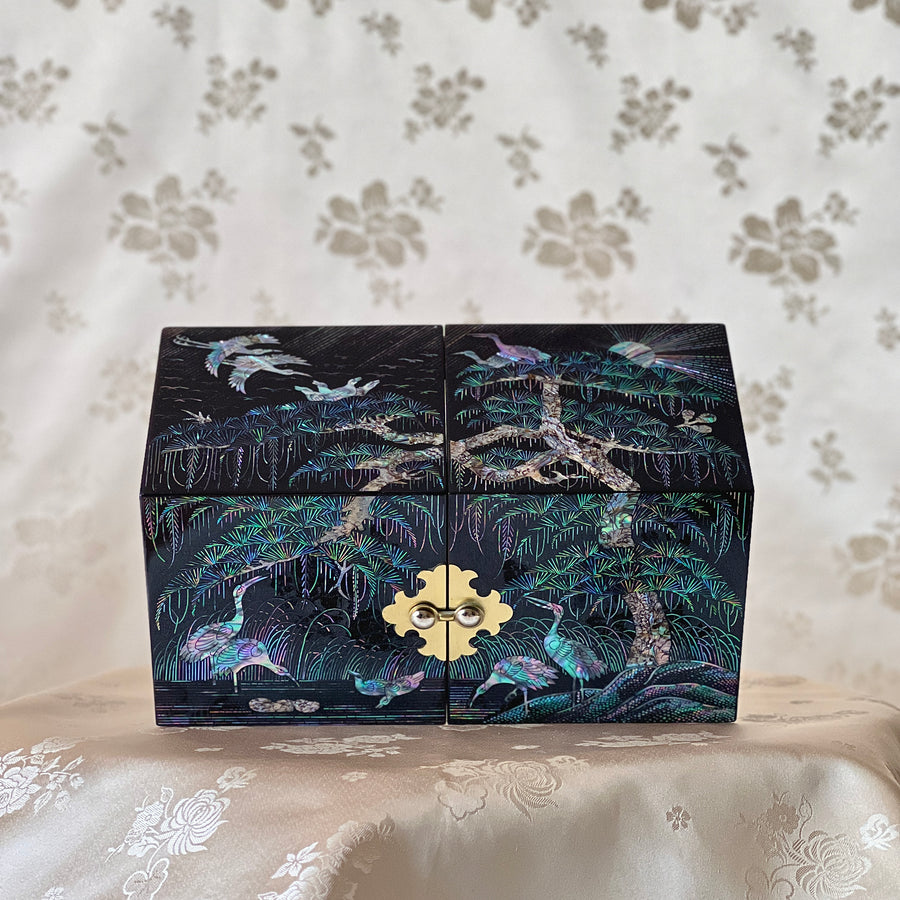
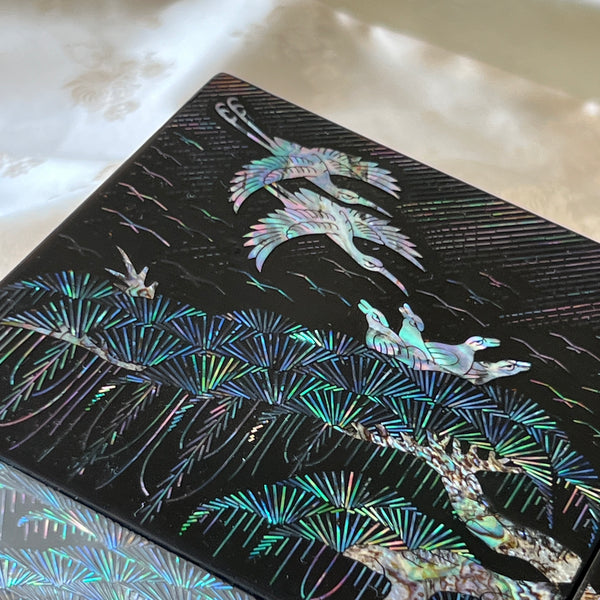
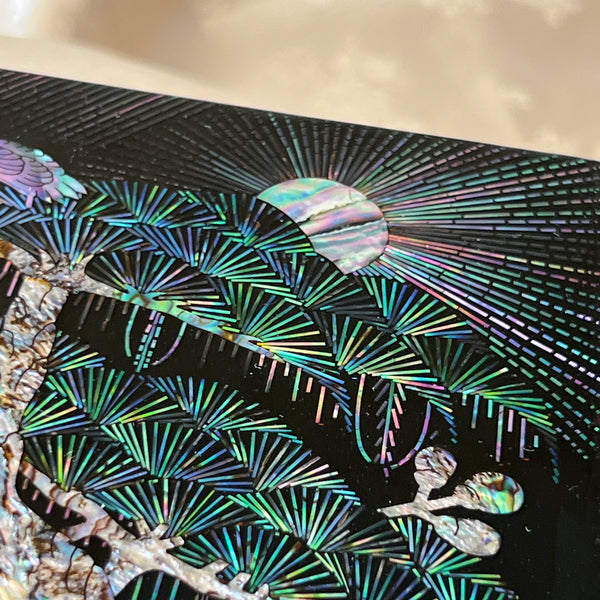
Then look at the cranes themselves, which are cut as whole shapes, and the trunk of the pine, which uses larger, irregular pieces. The result is the “two families” in a single picture. The shapes are jureumjil, and the threads are kkeuneumjil, working together.
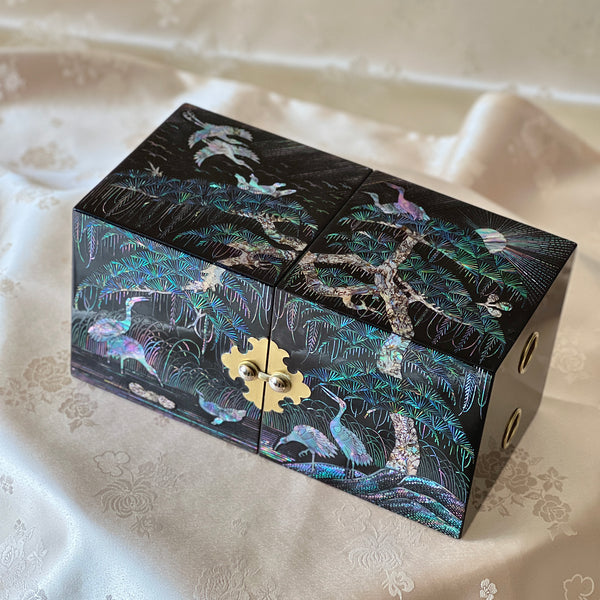
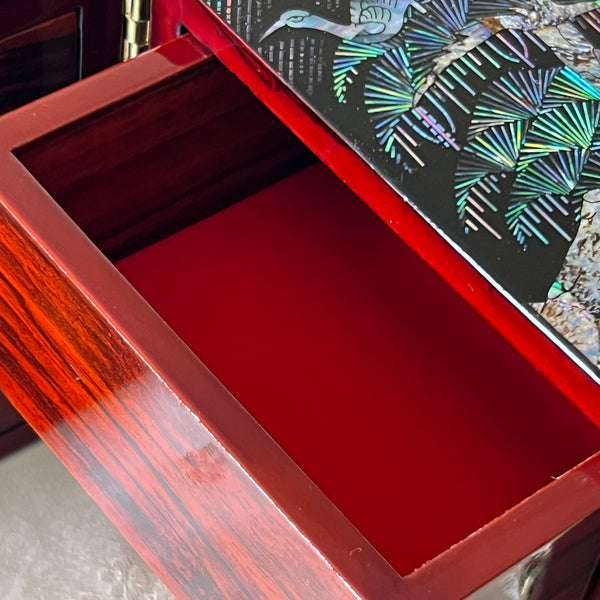
It is a double chest, two boxes hinged as one, and inside are red-lined drawers. At 25 cm wide it sits comfortably on a dresser.
See it in the gallery · Two
The Phoenix amid Peonies Box
Here the roles are reversed. The phoenix and flowers are shaped pieces of shell. The background is the technique itself: narrow strips laid in closely spaced horizontal lines, which steady the busy composition. Tilt the lid and you’ll see the lines catch the light in turn, one after another.
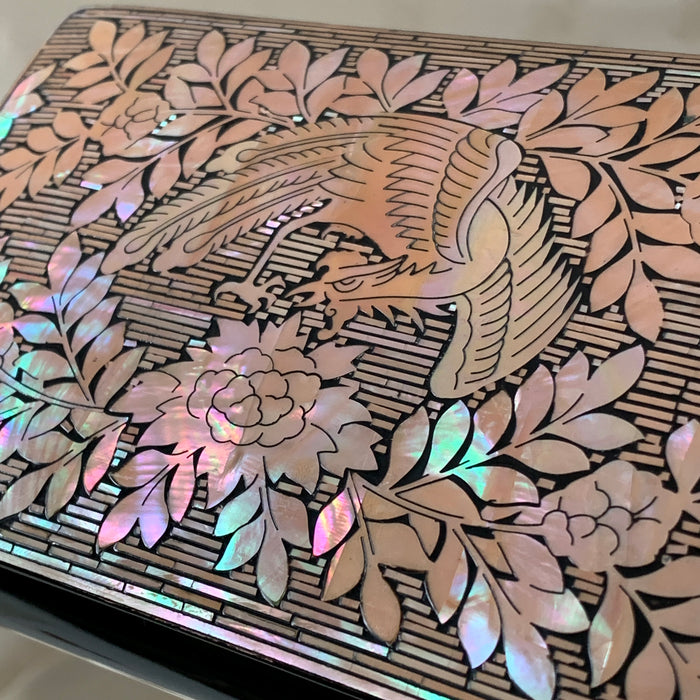
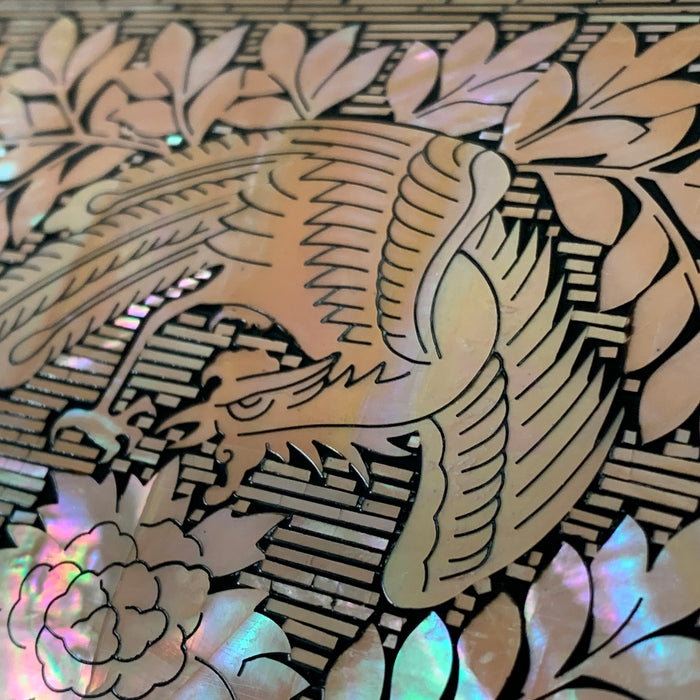
The box is small, 16 cm wide, and the effect is concentrated.
See it in the gallery · Three
The Ten Longevity Symbols Double Chest
Made by GaGyeong Art
This third piece turns the technique into weather. Look at the doors and you meet a deer family, a stag, a doe and a fawn, standing in a pine grove beside a stream, with cranes drifting through the trees. A key-pattern border frames each door, and a silver butterfly holds them closed.
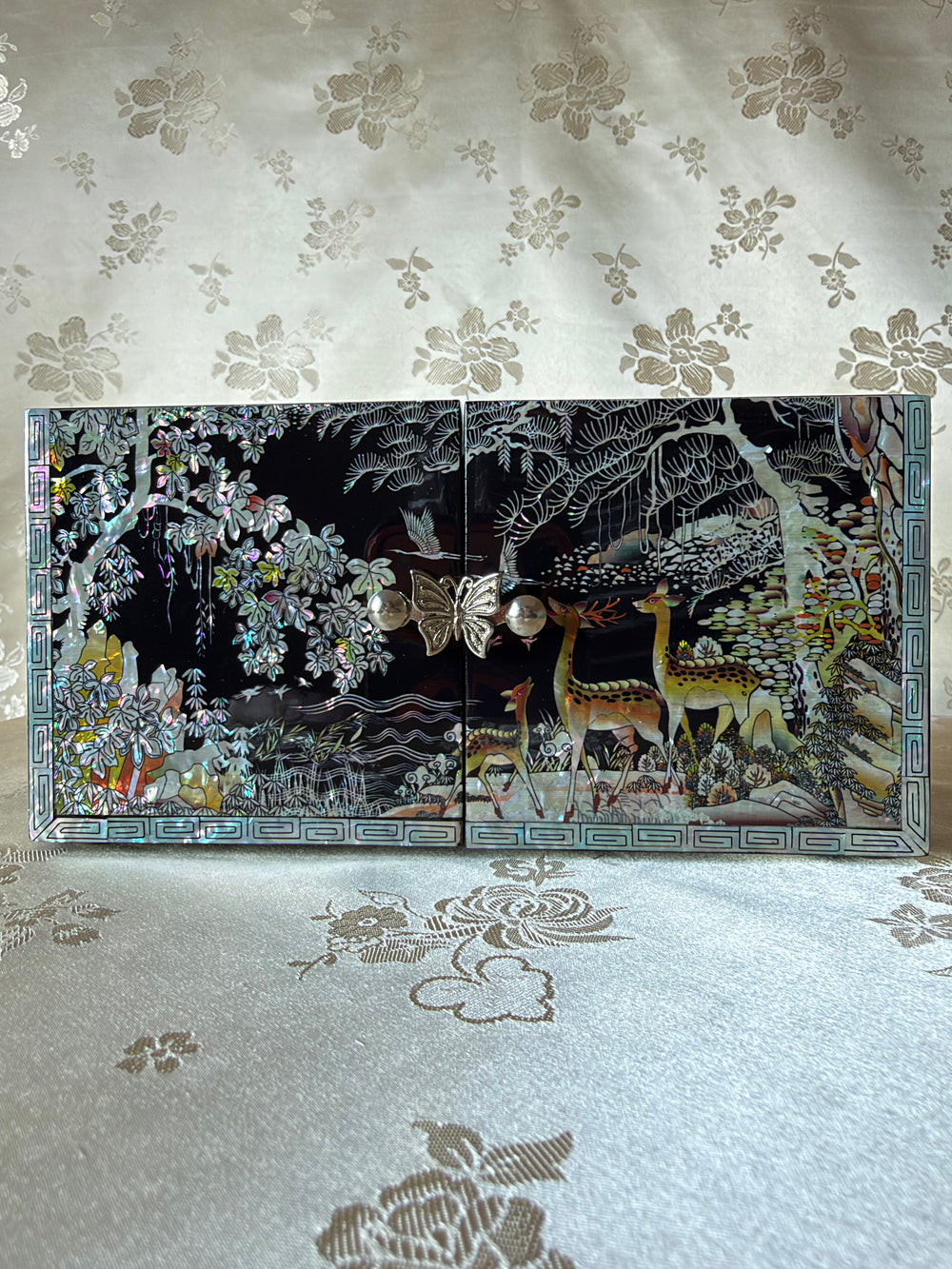
Now look at what the shell is doing. The pine canopy is drawn in fine, wiry lines, and the ripples across the water are slender curves laid one after another. Those are the places to look for cut threads. The deer, by contrast, are shaped pieces with warm gold and amber in them, so they glow against the cooler greens and blues around them.
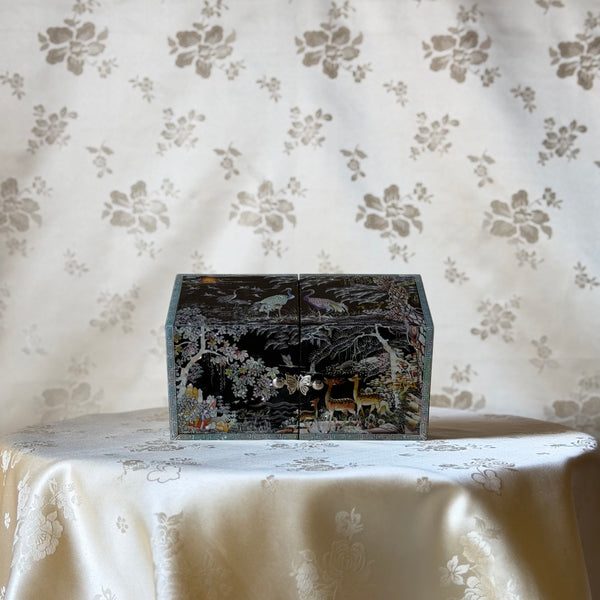
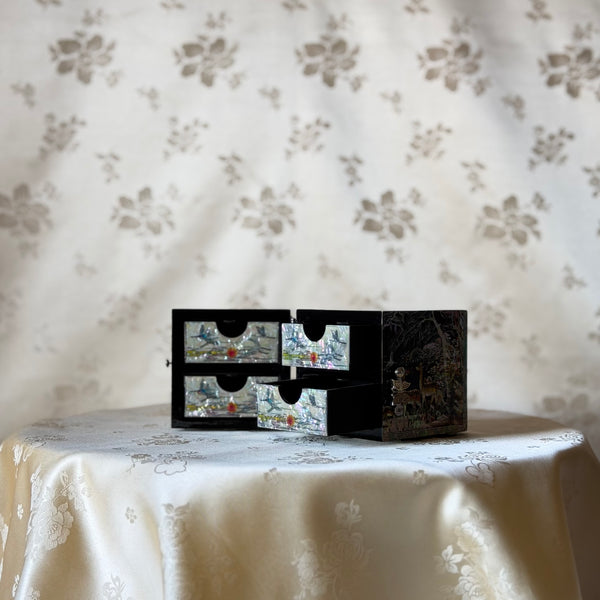
The listing counts ten longevity symbols. In the Korean tradition they are the sun, mountains, water, rocks, clouds, pine, turtle, crane, deer and the herb of immortality, and you can read more about them in our guide to the symbols of longevity. The doors are an easy place to find the deer, cranes, pine, water and rocks. Inside, small pull-out drawers have faces lined in shell and decorated with birds in flight, so the scene continues after you open the chest.
The workshop behind this chest is GaGyeong Art, in Seongnam, just southeast of Seoul, led by the craftsman Yoo Joong-ki. A 2009 profile in the Gyeonggi Ilbo described him as having spent more than forty years in najeonchilgi, working in both kkeuneumjil and jureumjil. It also noted that he was named a Gyeonggi “Best” craftsman (경기으뜸이) in 2003. He learned the trade as a teenager in the workshops of Seoul’s Yongsan district, and later became known for bringing najeon to small everyday objects, so that the tradition could reach more people.
See it in the gallery · Four
The Banquet Procession Screen
Made by GaGyeong Art
The last piece is the biggest canvas for the technique. A royal banquet procession unfolds across the folding screen, panel by panel: musicians, dancers, soldiers, horses, banners and ceremonial objects, all in shell. As the listing explains, the king himself is absent. The majesty of the court is told through the world around him, in the tradition of Korean royal paintings.
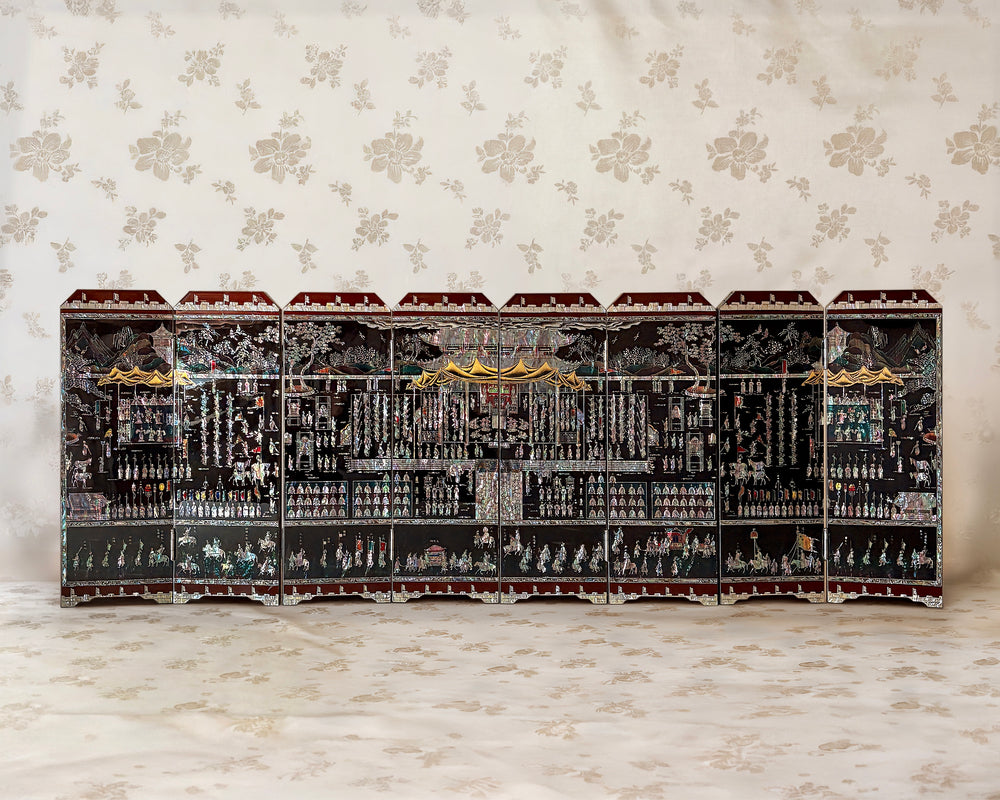
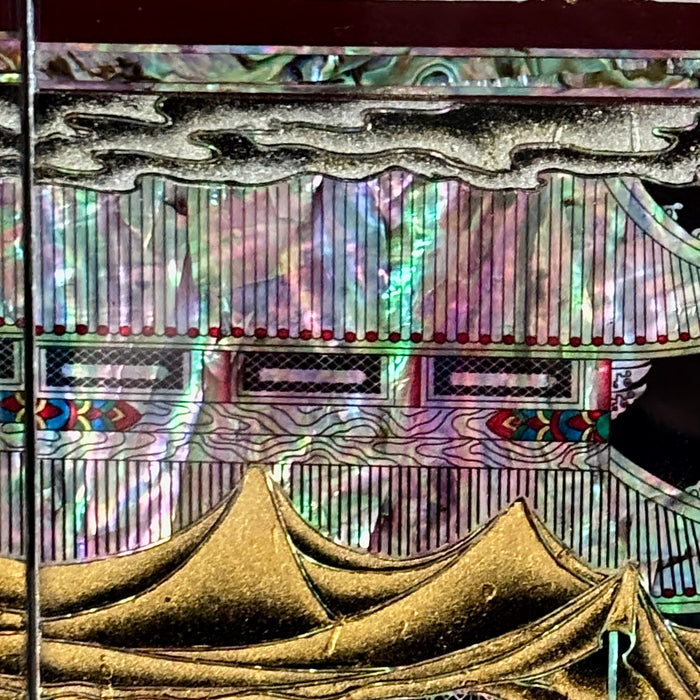
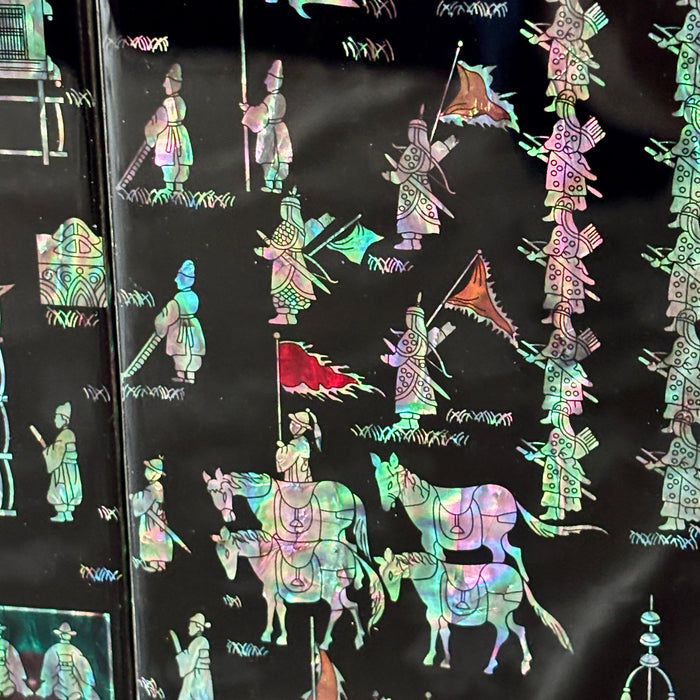
Look at the architecture first. The pavilion walls, railings and roofs are drawn in rows of long, parallel lines of shell, as if hatched with a ruler. A building is all straight lines, and straight lines are what cut threads do best. The soldiers, horses and attendants are different: they are shaped pieces, each with fine dark lines inside to mark faces, armour and folds. It is the same pairing as on the pine chest, now at the scale of a whole court.
The screen also changes through the day. The listing describes soft pastels in morning light, sharp clarity at midday, and a deeper glow by evening, which is exactly what you would expect from hundreds of separate pieces of shell catching light at different angles.
A Short Field Guide
Take these four habits with you the next time you look at any piece of najeon:
For care, keep these pieces out of direct sun and wipe them with a soft dry cloth. We cover the details in our mother-of-pearl care guide.
Why It Matters
Here is the thought we keep coming back to. A single thread of shell is almost invisible. It becomes a pine needle only beside a hundred others, and a pine only beside the sky, the water and the crane. That is a very Korean way of thinking about beauty: the individual stroke humbly serves the whole, and the whole is built from many small acts of attention.
It is also why we pair these pieces with the symbols of longevity we wrote about earlier. Cranes and pines stand for a long life, and the craft behind them was made patiently, one cut at a time.
A note on honesty, as always. Our pieces are contemporary works by living artisans, not antiques, and a modern workshop may use tools and methods that differ from the master-by-master descriptions above. What we can promise is that the line you see is built from cut shell, and that it is worth a long look.
For the wider tradition, start with our overview of Korean mother-of-pearl art.
Next week
We have made a promise three times now, and next week we keep it. Obangsaek, the five traditional Korean colours, is finally on the table.
Until then — look closely at the smallest line.