

Mother-of-Pearl Maebyeong Vase: Grand-Scale, Grape and Peony Motifs
- 世界網の積荷
- 在庫残りわずか - 1個のアイテムが残っています
- 途中の在庫
This piece is chosen by those who understand that richness may be held within discipline, and that an object can disclose itself slowly.
“The garden does not remain upon the surface; it moves with the light and continues beyond the eye.”
This Korean maebyeong is conceived as a vessel to be read in rotation. Its form appears calm and self-contained from a distance: a small mouth, a full upper body, a narrowing waist, and a firmly grounded base. Yet the surface resists a single frontal interpretation. Peonies, grapevines, leaves, fruit, and birds pass around the body in a continuous sequence, making movement around the vessel an essential part of viewing it.
The maebyeong form is particularly suited to this unfolding composition. Its broad shoulder provides space for the larger blossoms and spreading leaves, while the narrowing lower body draws stems, clusters, and smaller motifs into a more concentrated rhythm. The structure therefore guides the imagery. What appears expansive above becomes gathered below, allowing the visual abundance to remain contained within the discipline of the silhouette.
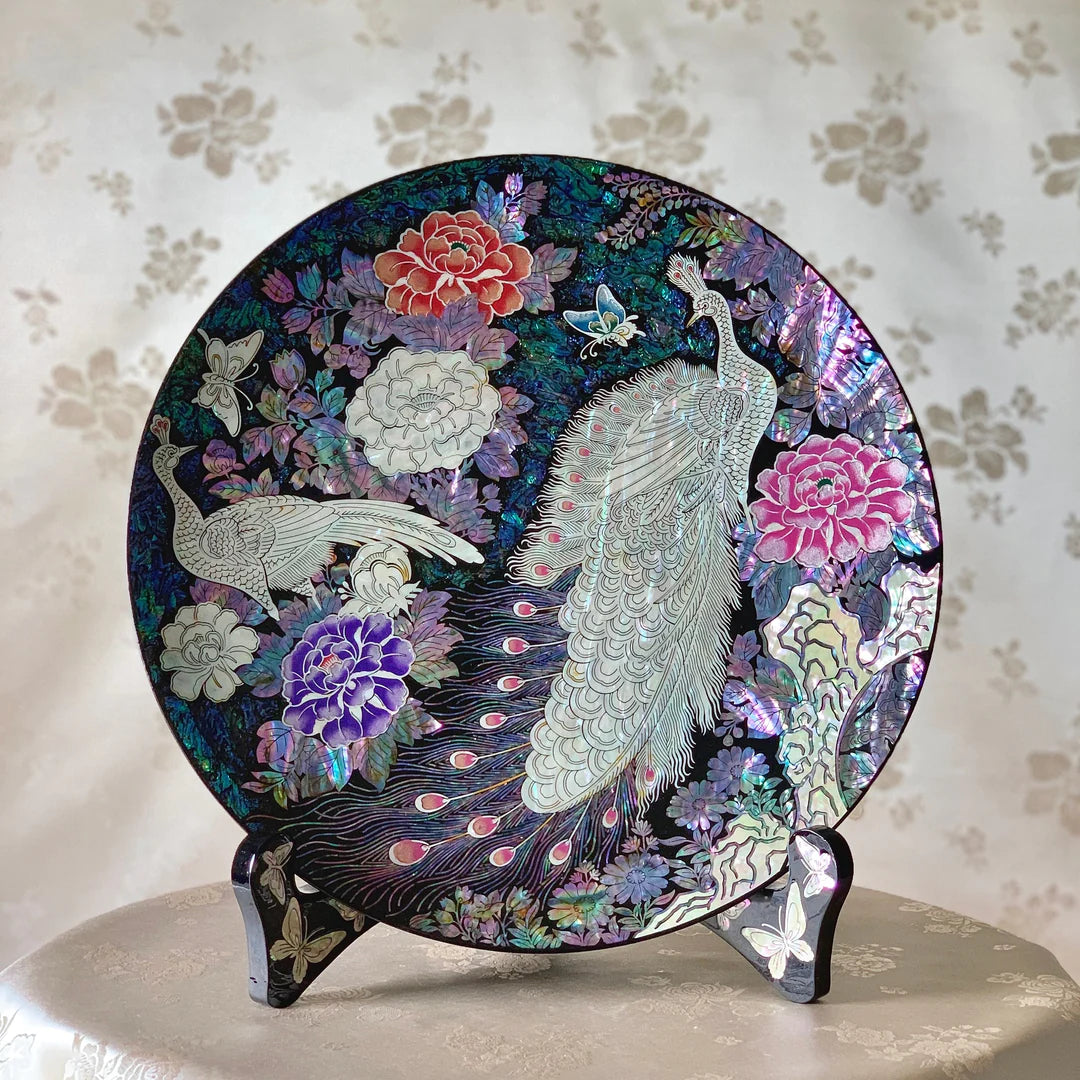
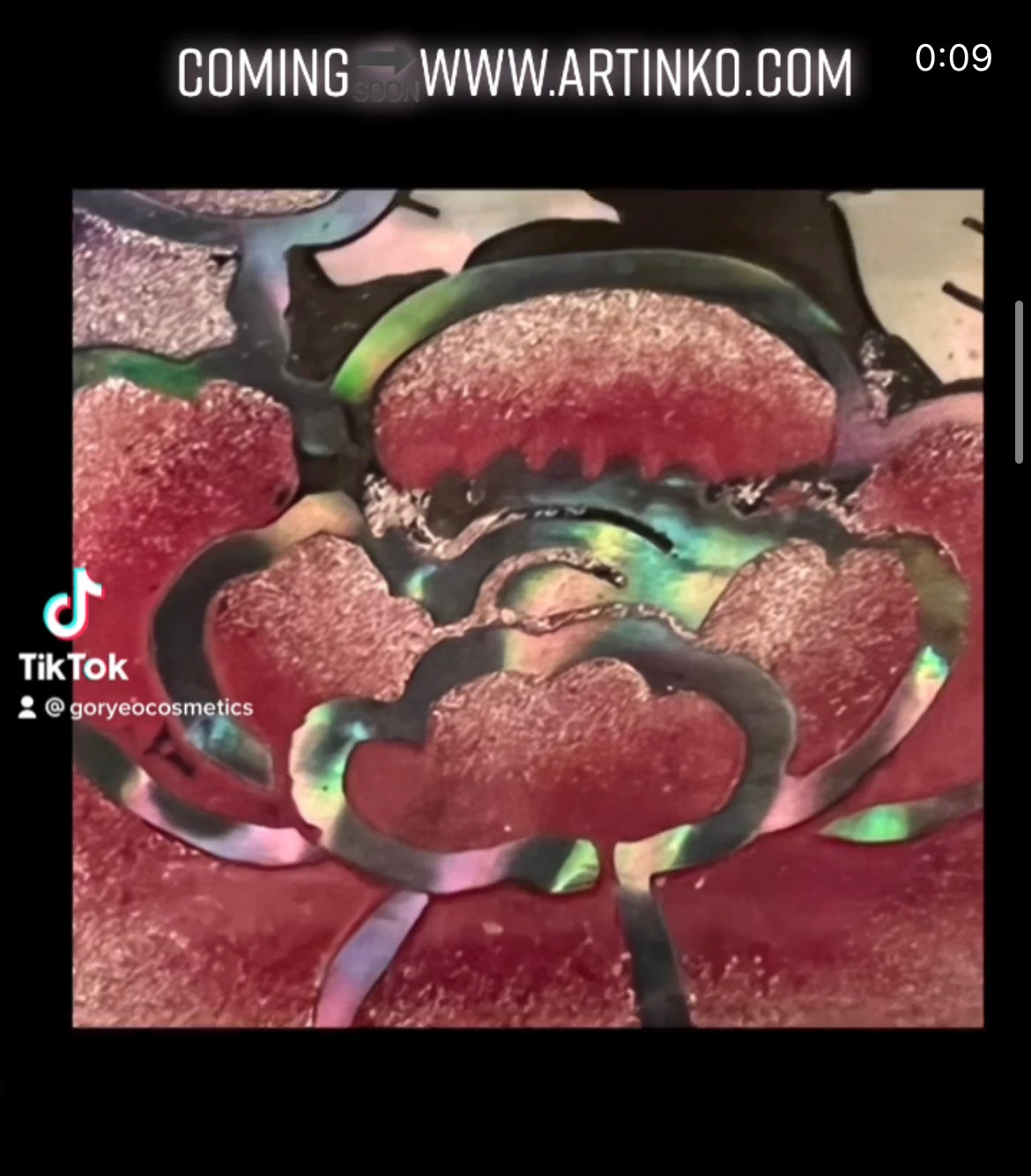
The shellwork ground has been assembled from numerous small, dark blue pieces. Seen closely, it has a mosaic-like order; seen from a distance, it becomes a deep, mutable field. This decision is central to the work. A plain surface would separate image from vessel too clearly. Here, the shell ground dissolves that boundary. Flowers and fruit emerge from within an already active material environment, so that figure and background repeatedly exchange prominence as the light moves.
The peony passages are arranged as intervals of opening. Some blossoms are fully spread, while others remain more closely gathered. Their pale surfaces hold light against the darker ground, creating moments of breadth and stillness. In Korean decorative culture, the peony conveys prosperity, honour, beauty, and fullness. Its role here, however, is not simply emblematic. The flower also establishes the emotional register of the vessel: generous, composed, and mature rather than delicate or fleeting.
The grapevine passages introduce a different order. Grapes gather through repetition; their meaning lies in multiplicity. Purple, green, and pale clusters hang among leaves, while small birds bring subtle animation to the scene. The vine’s extension and the abundance of its fruit have made it a fitting image of continuity and flourishing. Placed opposite the peonies, the grape motif shifts the idea of abundance from ceremonial bloom to sustained growth.
This pairing explains why the object was composed in this way. Peonies present abundance as expansion: petals opening outward into space. Grapes present abundance as accumulation: many fruits held together along a living stem. The two motifs are related, but not redundant. Together, they describe fullness through two distinct visual languages—flowering and ripening.
The work also changes according to the viewer’s position. From one side, the vessel appears primarily floral, with large blossoms holding the surface in measured intervals. From another, it becomes denser and more narrative, with fruit, leaves, and birds occupying the field. There is no definitive front. The object encourages repeated looking because each turn alters the relationship between motif, silhouette, and reflection.
This rotational experience is intensified by the behaviour of the shell. Under diffused light, the vessel appears dark, restrained, and almost nocturnal. Under direct light, blue, green, violet, and silver tones rise across the surface. The imagery does not merely become brighter; its hierarchy changes. A flower that had seemed dominant may recede, while a leaf, bird, or cluster of grapes becomes momentarily distinct. Light therefore acts as a second form of composition.
The technical labour is most evident where the imagery crosses the vessel’s curves. Shell pieces applied to the shoulder must accommodate outward expansion; those at the waist must follow compression; those approaching the base must return the composition to stability. The maker’s task is not simply to cover the form, but to preserve the integrity of both image and contour. The finished surface appears continuous because numerous small decisions have been absorbed into the whole.
At approximately 30 centimetres in height, the vessel occupies an intimate architectural scale. It is substantial enough to hold a room’s attention, yet close enough for the shell pieces, engraved lines, colour transitions, and natural irregularities to be examined directly. Its presence rests neither in simplicity nor in unchecked splendour, but in the controlled tension between them.
What remains after prolonged viewing is not the impression of a static floral vase. The work behaves more like a seasonal world held within a single form. Flowers open, grapes ripen, birds move between branches, and the deep blue field shifts from dusk to light. The vessel is never entirely still, even when untouched.
Dimensions
- Diameter- 25cm (9.84 inch)
- Height- 45cm (17.72 inch)
Related Links
世界中に発送いたします。以下は当社の配送ポリシーを構成する利用規約です。
発送処理時間
- すべての注文は、支払いの受領後 5 日以内に処理されることを目指しています。ご注文は土日祝日は発送されません。
- ご注文が集中した場合、発送が数日遅れる場合がございます。ご注文の発送が遅れる場合には、メールでご連絡させていただきます。
配送料と配送目安
- すべての注文は、K-Packet、航空便、EMS、速達宅配便 (UPS、Fedex、DHL など) で発送されます。
- ゆうパケット発送は基本的な発送サービスです。 K-Packet の推定配送時間は、お住まいの地域に応じて 14 ~ 21 日です。重量が2kgを超える場合はKパケット便から航空便に変更させていただきます。
- EMS の推定配送時間は、地域によって異なりますが、7 ~ 14 日です。航空便による配送方法は国によっては利用できない場合があることにご注意ください。
- 速達の推定配送時間は 5 ~ 10 日です。
- ご注文の送料はチェックアウト時に計算されて表示されます。
- 小包は可能な限り追跡されて発送され、注文が処理されると追跡番号が記載された自動メールが届きます。
私書箱への発送
- 私書箱に発送します
出荷確認と注文追跡
- ご注文の発送が完了すると、追跡番号が記載された発送確認メールが届きます。
損害賠償
- Artinko は、配送中の製品の破損または紛失については責任を負いません。受け取ったご注文が破損していた場合は、写真を撮ってできるだけ早くご連絡ください。解決できるよう努めます。
関税
- あなたの荷物は到着時にあなたの国の税関の対象となる場合がありますのでご了承ください。関税は受取人の責任となります。
- これらの料金については当社では管理できないことにご注意ください。現地の税関で荷物が長期間保留されている場合、配達時間が遅れる場合もあります。
配送に問題がある場合は、goryeo.artinko@gmail.com までメールをお送りください。