Those who choose this piece are often attentive to the small decisions through which traditional craftsmanship acquires its character.
“Within a narrow rectangular field, the phoenix moves through a garden of peonies, while the surrounding shell catches and releases the light.”
The first impression of this Korean mother-of-pearl box is one of considerable detail contained within a modest form. Almost the entire decorative programme has been reserved for the lid. Beneath it, the rectangular body is finished in uninterrupted black lacquer, with no attempt to extend the floral imagery over its sides. This division is essential to the composition. The richness of the upper surface is made more apparent by the plainness of the box that supports it.
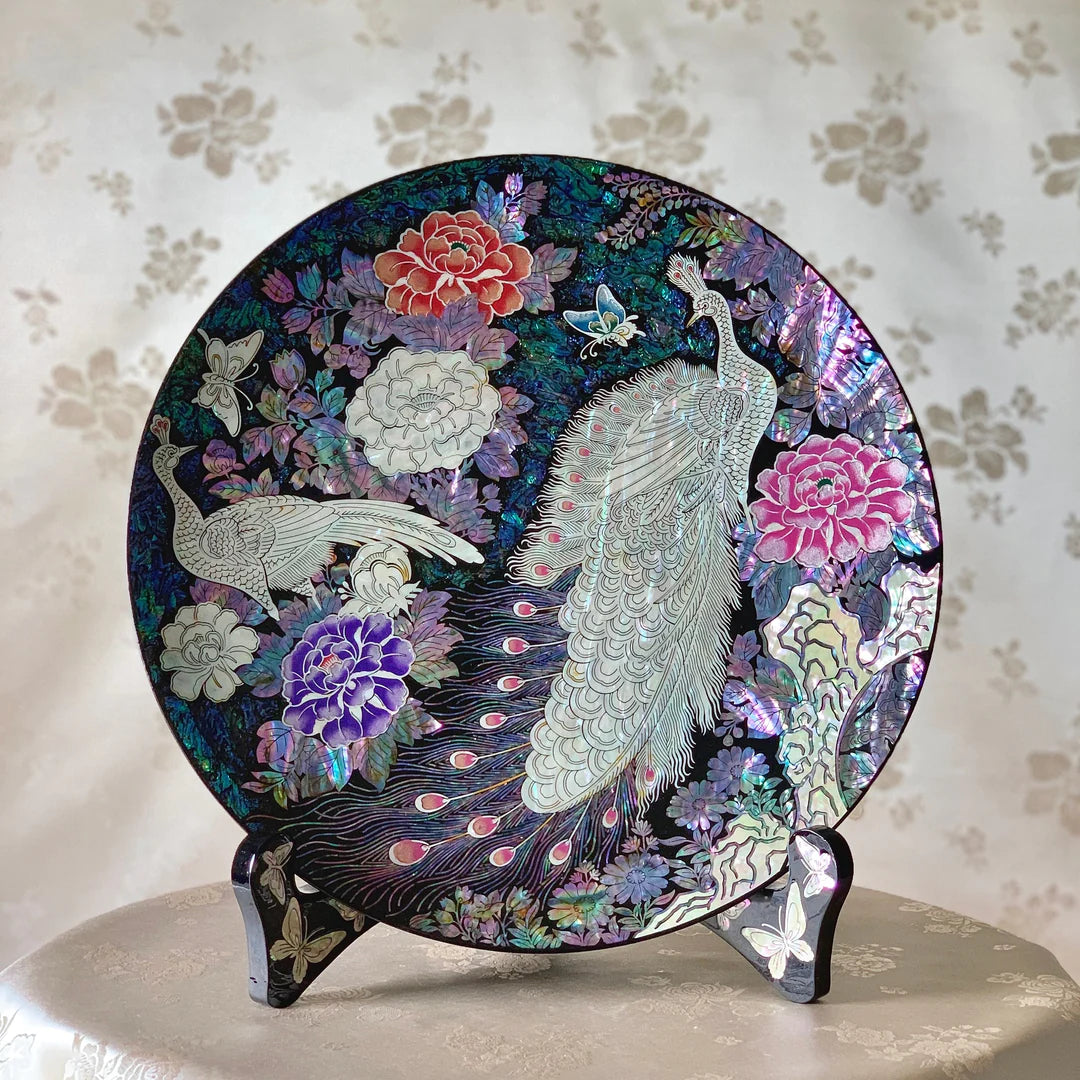
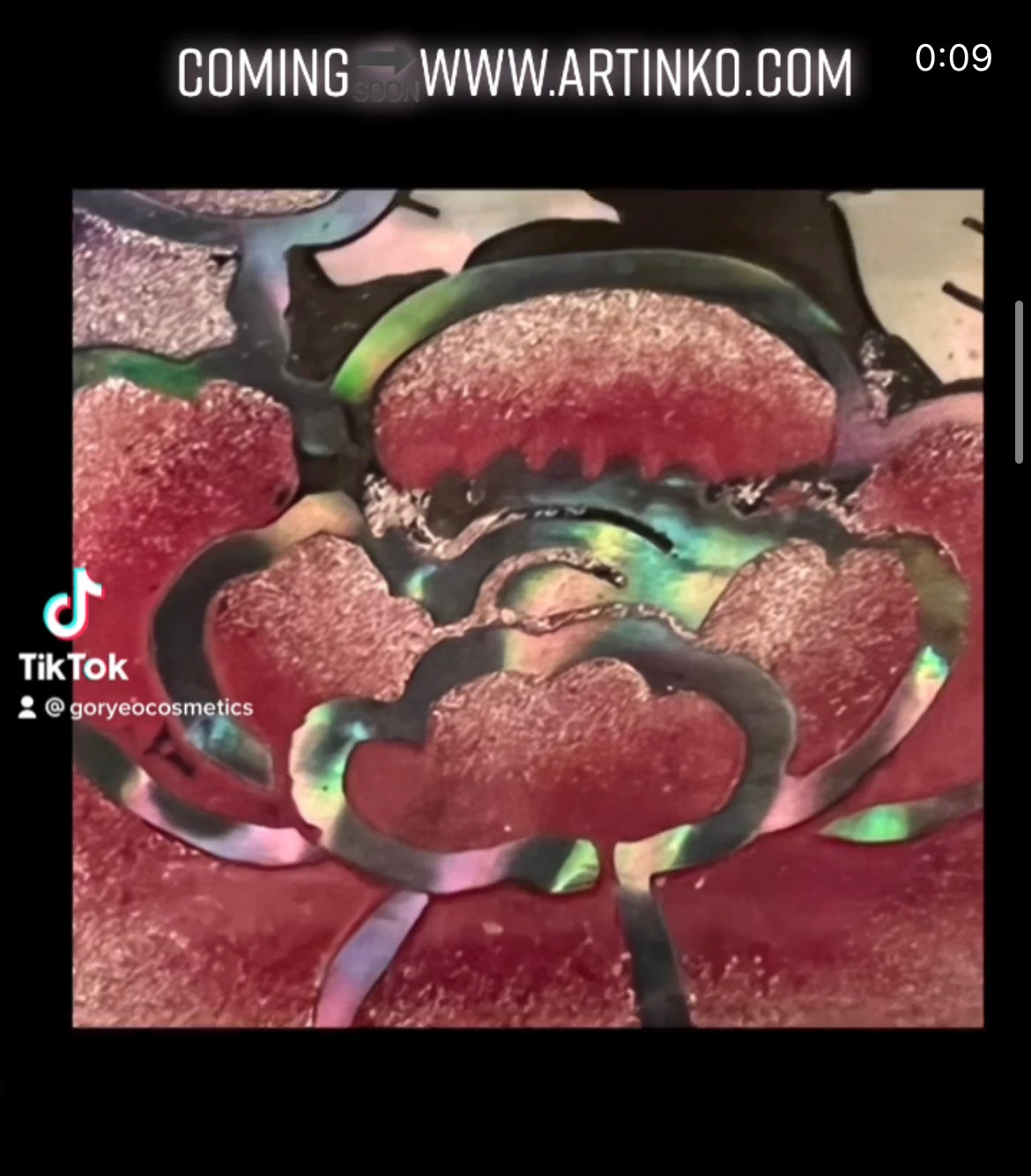
Across the lid, a phoenix extends its wings within a closely arranged setting of peonies, stems and leaves. Its body introduces a diagonal movement through the composition, while the surrounding branches spread in several directions, occupying the corners and edges without obscuring the central figure. The bird and flowers share the same surface, yet remain clearly distinguishable through the different shapes of their shell pieces and the fine lines defining their forms.
The choice of these motifs draws upon a familiar language of Korean auspicious imagery. The phoenix, or bonghwang, has historically been associated with harmonious order, peace and virtuous authority. Unlike the Western phoenix, whose symbolism is commonly centred on rebirth, the Korean bonghwang belongs to a broader East Asian tradition in which the mythical bird signifies an auspicious and well-ordered world.
The peony carries a complementary meaning. Long admired for its full blossoms, it became associated in Korean art with prosperity, honour and abundance. Peonies appeared widely in painting, textiles, furniture and household objects, where their presence expressed hopes for a flourishing life.
In this composition, the phoenix and peonies are closely connected. The bird’s extended wings give movement to an otherwise densely arranged floral field, while the blossoms soften the angular forms of its feathers and establish a sense of continuity across the lid. Neither motif is isolated within a separate border. The phoenix occupies the garden rather than standing apart from it.
The workmanship becomes particularly apparent when the surface is examined closely.
The larger shell pieces forming the phoenix, flowers and foliage have been cut to follow their individual contours. The feathers require longer, more directional shapes; the peony petals are rounded and gathered; and the leaves are divided into smaller forms that follow the movement of the branches. Thin dark lines define the relationships between these elements, allowing the imagery to remain legible despite the closely packed composition.
Behind them lies a second, less immediately noticeable form of craftsmanship.
The background consists of numerous narrow shell strips arranged in closely spaced horizontal sequences. This traditional method, known as kkeuneumjil, requires the shell to be cut into fine lengths and positioned with considerable care. Individual strips must follow an established direction while accommodating the irregular outlines of the surrounding imagery.
This creates an interesting distinction between the two types of shellwork. The phoenix and peonies depend upon varied shapes and curves; the background is built from repeated, predominantly straight elements. One establishes the imagery, the other gives the entire surface a measured structure.
The meeting points between them are especially revealing. Around the ends of leaves, along the curved petals and beneath the outstretched wings, the narrow background strips must be brought into close relation with the shaped shell pieces. The work requires care not only in cutting each element, but in maintaining the clarity of the design as the separate pieces come together.
The natural qualities of the shell introduce a further dimension. Much of the surface appears pale pink or softly silver-toned, yet passages of blue, green and violet emerge as the lid catches light from different directions. These changes are particularly noticeable across the phoenix’s wings and the surrounding foliage. The underlying arrangement remains fixed, but the balance of colour changes with the viewing angle.
That movement of light is kept within a remarkably controlled composition. The repeated horizontal strips hold the background steady, while the botanical forms and the bird introduce more varied directions. The design remains detailed without losing its overall coherence.
The body of the box offers a deliberate change in character. Its black lacquer surface is smooth and unadorned, allowing the rectangular shape and slightly softened corners to be appreciated without distraction. This restraint continues inside. Removing the lid reveals a plain black compartment, free from the elaborate imagery above.
The contrast between closed and opened states gives the object a natural sequence. When closed, attention rests on the phoenix, the peonies and the changing reflections of the shell. Opening it shifts attention to the contents and the simple interior. The decorated lid becomes a separate surface to be handled and viewed, while the box beneath continues its practical purpose.
There is something particularly considered about this arrangement. The artisan has not attempted to demonstrate the same decorative skill on every available surface. Instead, the most demanding work is concentrated where it can be seen as a complete composition, leaving the rest of the object deliberately quiet.
The box preserves an important characteristic of Korean mother-of-pearl craftsmanship: the ability to transform small pieces of natural shell into a finely organised image without losing the material’s individual response to light.
Its appeal develops through close observation — first the phoenix and peonies, then the narrow strips behind them, and finally the contrast between the decorated lid and the plain black body. Each level reveals a different aspect of the workmanship, while the object itself remains modest and purposeful.
Dimensions
- Width- 16cm (6.3 inch)
- Depth- 10cm (3.94 inch)
- Height- 4cm (1.57 inch)
Related Links