

Mother-of-Pearl Musical Jewelry Box: Peony Motif on Purple Hanji Ground
- 世界網の積荷
- 在庫残りわずか - 1個のアイテムが残っています
- 途中の在庫
Chosen by those who value objects that do not yield themselves at once, but deepen through ritual, memory, and repeated looking.
“A quiet pageant of colour and song rests within this small and deliberate form.”
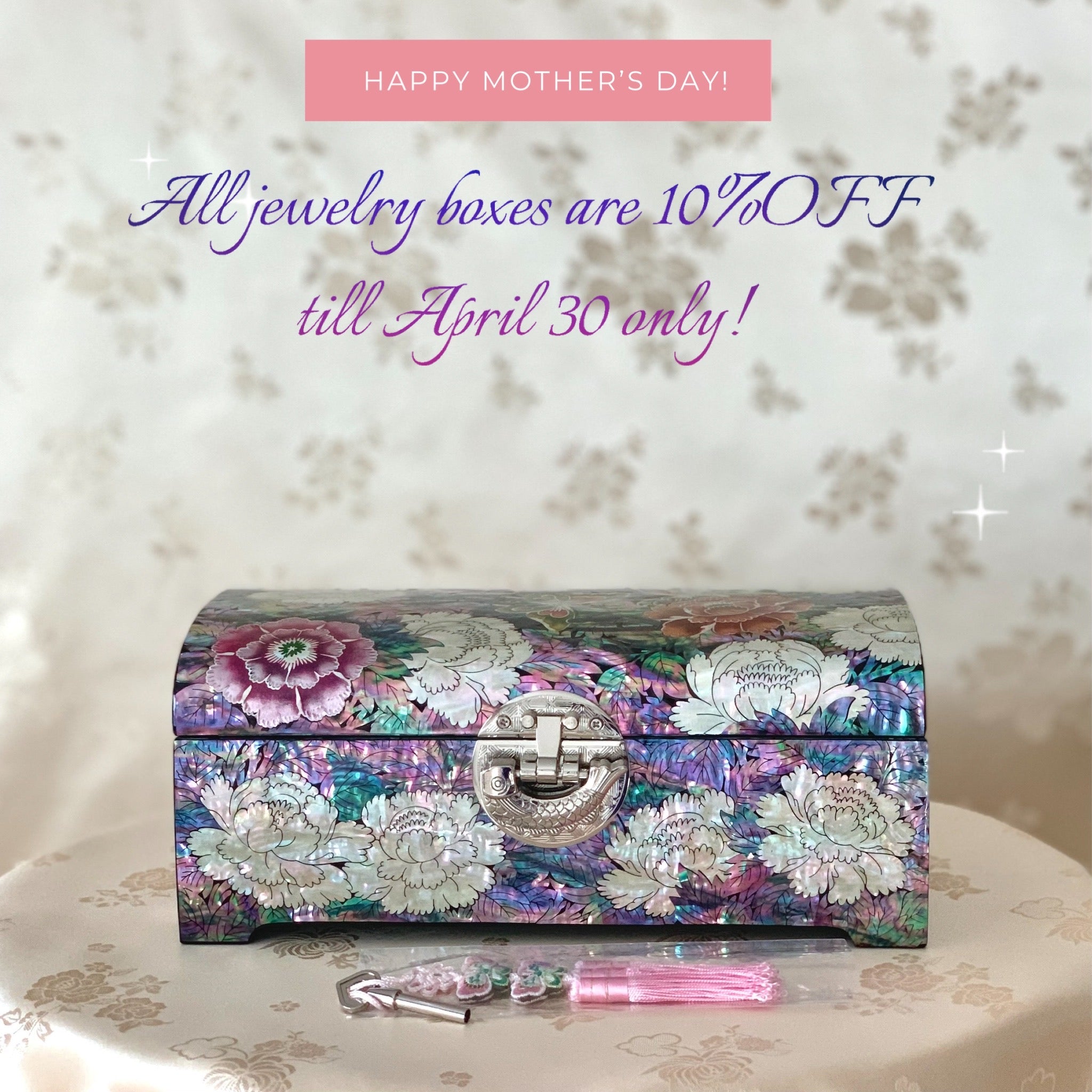
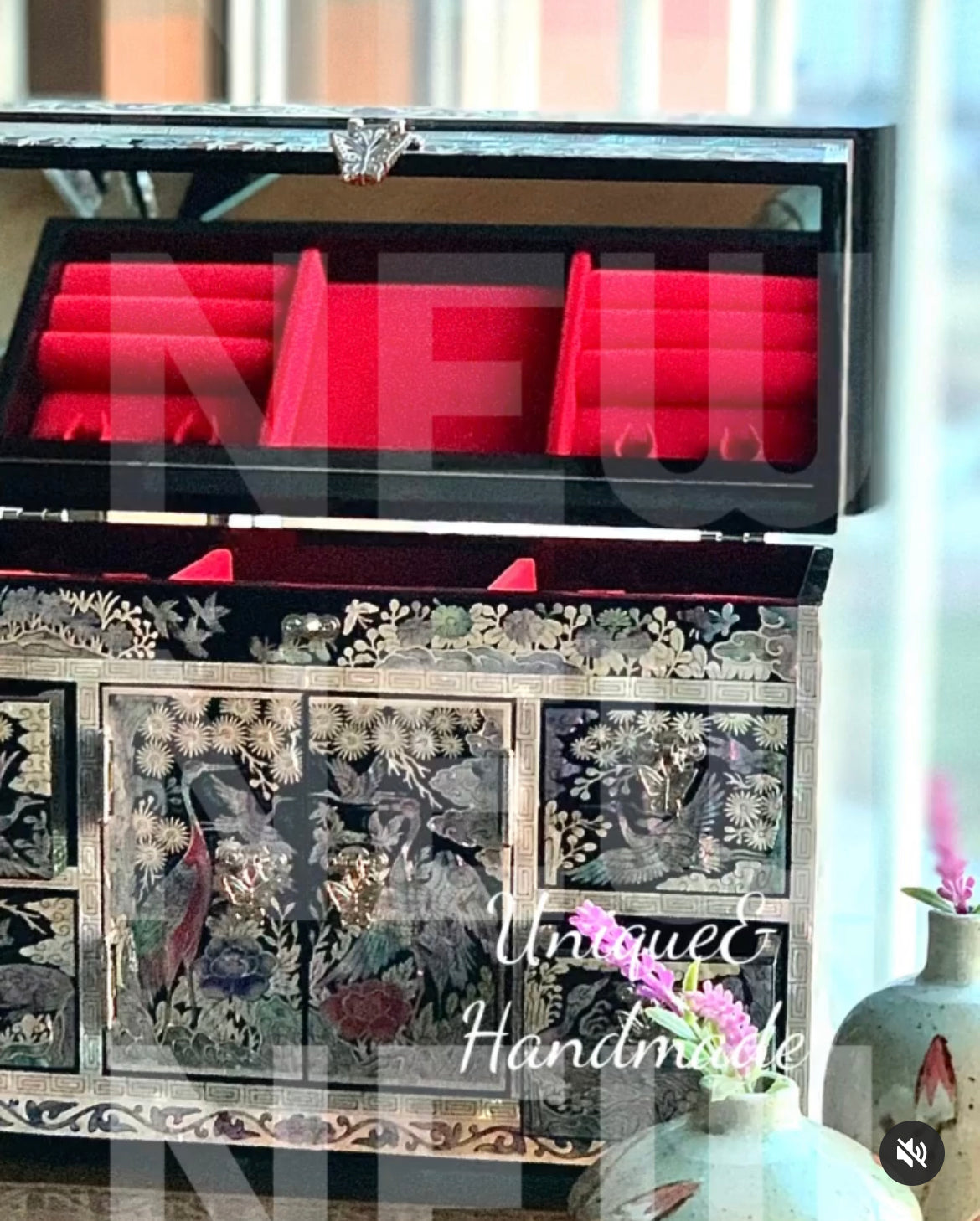
This musical jewelry box is shaped not simply as a container, but as a sequence of revelations. At first encounter, it appears composed and self-contained: a compact casket raised on a softly shaped foot, its silhouette calm, balanced, and almost architectural. Yet the longer one remains with it, the more the surface begins to unfold. The deep purple hanji ground is central to this experience. Its marbled, fibrous texture lends the box an atmosphere that is at once rich and restrained, as though colour had been held slightly back within the body of the object rather than spread across it. The hanji does not merely support the decoration. It gives the work its inward tone.
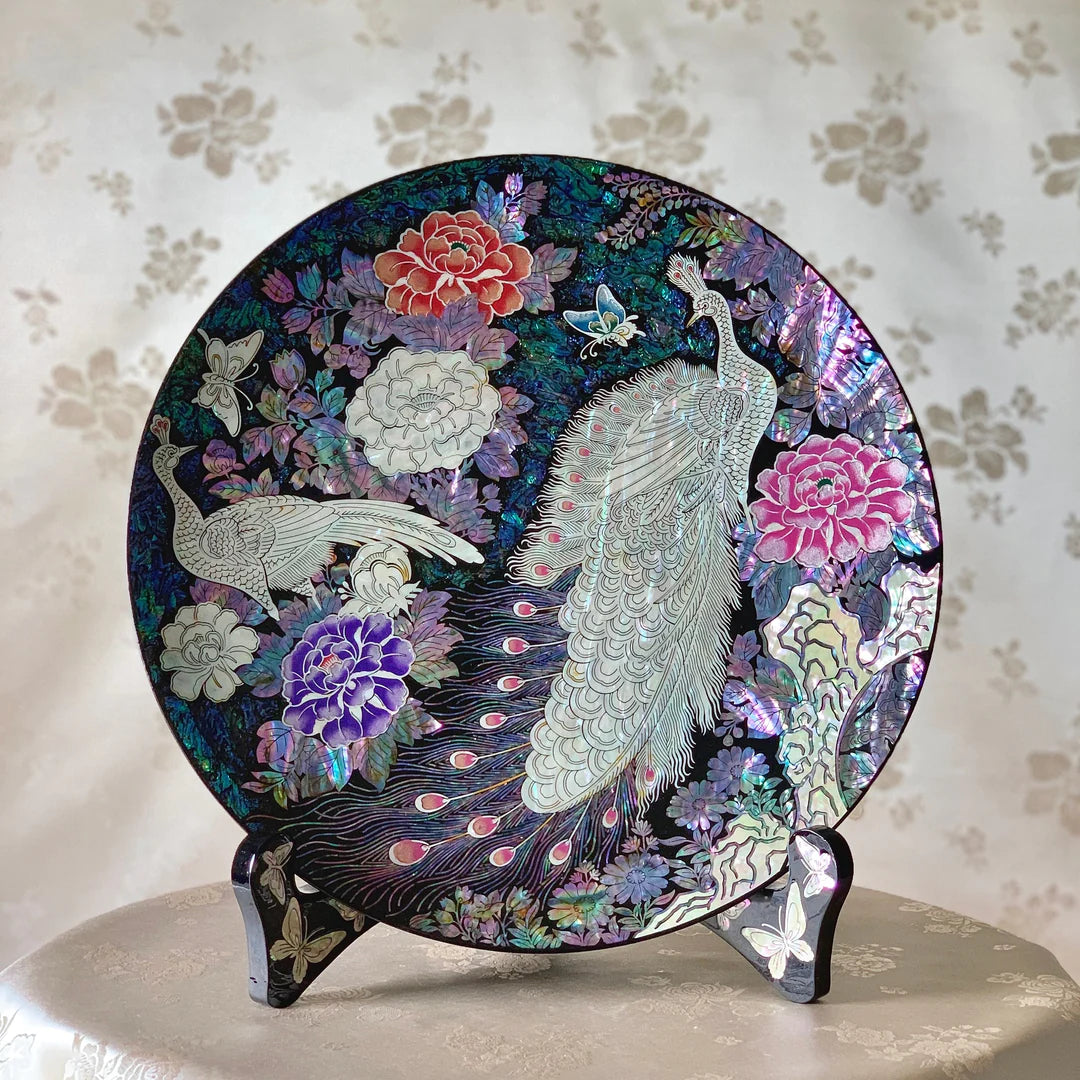
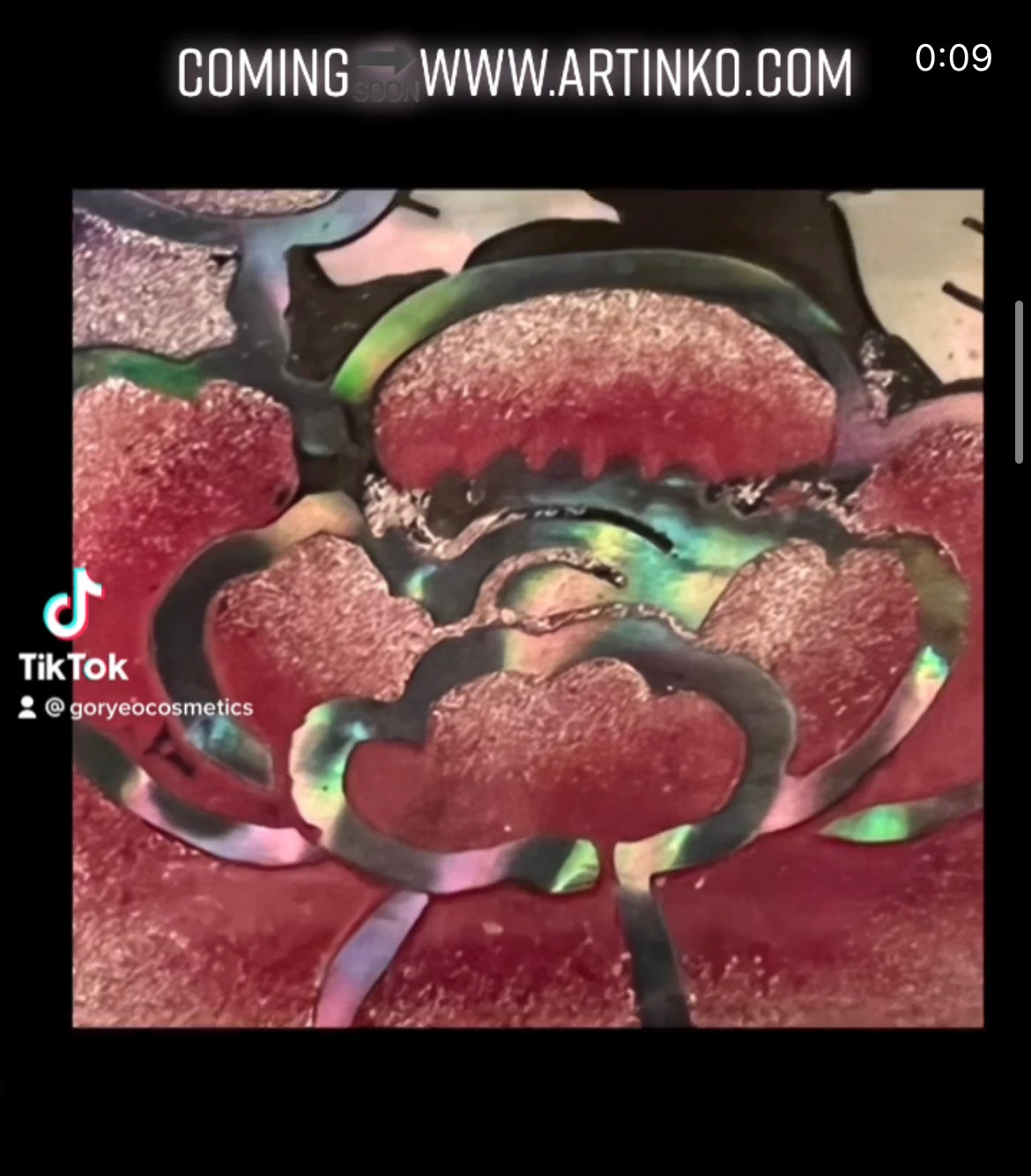
Against this dark violet field, the applied shellwork emerges with particular clarity. Thin shell pieces have been cut and set by hand into the forms of peacocks, butterflies, and peonies, each placed with measured restraint. The imagery is not crowded, nor does it seek spectacle through density. Instead, the motifs are distributed with an assured sense of pause and continuation. The lid carries the most elaborate scene, where the paired peacocks appear among peony blossoms and delicate butterflies, while the front and side panels extend the visual language in quieter fragments. This progression matters. The box does not present itself through a single emphatic face; it asks to be turned, and with each angle the imagery resumes in a slightly altered register.
The peony is especially important here. Within Korean decorative tradition, it has long signified abundance, honour, and cultivated prosperity, but in this work it does more than announce auspicious meaning. It anchors the composition. Its rounded fullness gives the more linear forms around it a centre of gravity, allowing the birds and butterflies to move without dispersing the image. The butterflies, light and briefly suspended, introduce an essential note of transience. They soften the authority of the larger motifs and bring the suggestion of season, affection, and passing life. The peacocks, by contrast, establish poise. Their elongated necks and layered tails give the scene its ceremonial dignity. Together, these elements create a distinctly Korean symbolic harmony in which prosperity is not rendered as excess, but as balance: dignity held alongside vitality, beauty held alongside order.
This sense of order is reinforced by the structure itself. The body swells gently before settling into its base, giving the box a quiet physical assurance. Its volume feels contained rather than heavy. The silver-toned fittings at the front, bright against the purple ground, introduce a formal point of tension: cool metal against warm paper, reflective hardness against softened surface. The fish-shaped lock is particularly eloquent in this regard. It transforms opening into an intentional act. With the slim key, the owner does not merely gain access to the interior; one passes through a small ceremony of touch, pause, and release. The object thereby resists haste. It establishes, even before opening, that what is held inside belongs to a slower order of attention.
When the lid is lifted, the work changes character. Its outer stillness gives way to an interior designed around intimacy and sound. A mirror appears within the lid, and a velvet-lined tray rises with it, arranged to hold rings or earrings in careful readiness. Beneath, a deeper lower compartment offers space for more substantial personal belongings, less constrained by size and more private in nature. At the same moment, the melody of Arirang begins to sound. This is a crucial transformation. The box moves from image to experience, from visible craft to remembered feeling. The melody does not function as embellishment alone; it draws Korean cultural memory into the act of opening, so that the object becomes not only a place for keeping jewelry, but a vessel for a private and repeated moment.
What gives this piece its particular distinction is the accord between its elements. The violet hanji ground, the luminous shell pieces, the peacock and peony imagery, the butterflies, the fish lock, the mirror, the velvet interior, and the sounding of Arirang all belong to a single emotional structure. Nothing appears merely added. The exterior prepares the mind through stillness and symbolism; the interior answers with reflection, storage, and song. In this way, the box is composed less as an accessory than as a lived encounter between craftsmanship and memory.
It remains most fully itself when approached without hurry, opened with intention, and allowed to speak in its own measured sequence.
Dimensions
- Width- 21cm (8.26 inch)
- Depth- 16cm (6.29 inch)
- Height- 12cm (4.72 inch)
Related Links
世界中に発送いたします。以下は当社の配送ポリシーを構成する利用規約です。
発送処理時間
- すべての注文は、支払いの受領後 5 日以内に処理されることを目指しています。ご注文は土日祝日は発送されません。
- ご注文が集中した場合、発送が数日遅れる場合がございます。ご注文の発送が遅れる場合には、メールでご連絡させていただきます。
配送料と配送目安
- すべての注文は、K-Packet、航空便、EMS、速達宅配便 (UPS、Fedex、DHL など) で発送されます。
- ゆうパケット発送は基本的な発送サービスです。 K-Packet の推定配送時間は、お住まいの地域に応じて 14 ~ 21 日です。重量が2kgを超える場合はKパケット便から航空便に変更させていただきます。
- EMS の推定配送時間は、地域によって異なりますが、7 ~ 14 日です。航空便による配送方法は国によっては利用できない場合があることにご注意ください。
- 速達の推定配送時間は 5 ~ 10 日です。
- ご注文の送料はチェックアウト時に計算されて表示されます。
- 小包は可能な限り追跡されて発送され、注文が処理されると追跡番号が記載された自動メールが届きます。
私書箱への発送
- 私書箱に発送します
出荷確認と注文追跡
- ご注文の発送が完了すると、追跡番号が記載された発送確認メールが届きます。
損害賠償
- Artinko は、配送中の製品の破損または紛失については責任を負いません。受け取ったご注文が破損していた場合は、写真を撮ってできるだけ早くご連絡ください。解決できるよう努めます。
関税
- あなたの荷物は到着時にあなたの国の税関の対象となる場合がありますのでご了承ください。関税は受取人の責任となります。
- これらの料金については当社では管理できないことにご注意ください。現地の税関で荷物が長期間保留されている場合、配達時間が遅れる場合もあります。
配送に問題がある場合は、goryeo.artinko@gmail.com までメールをお送りください。