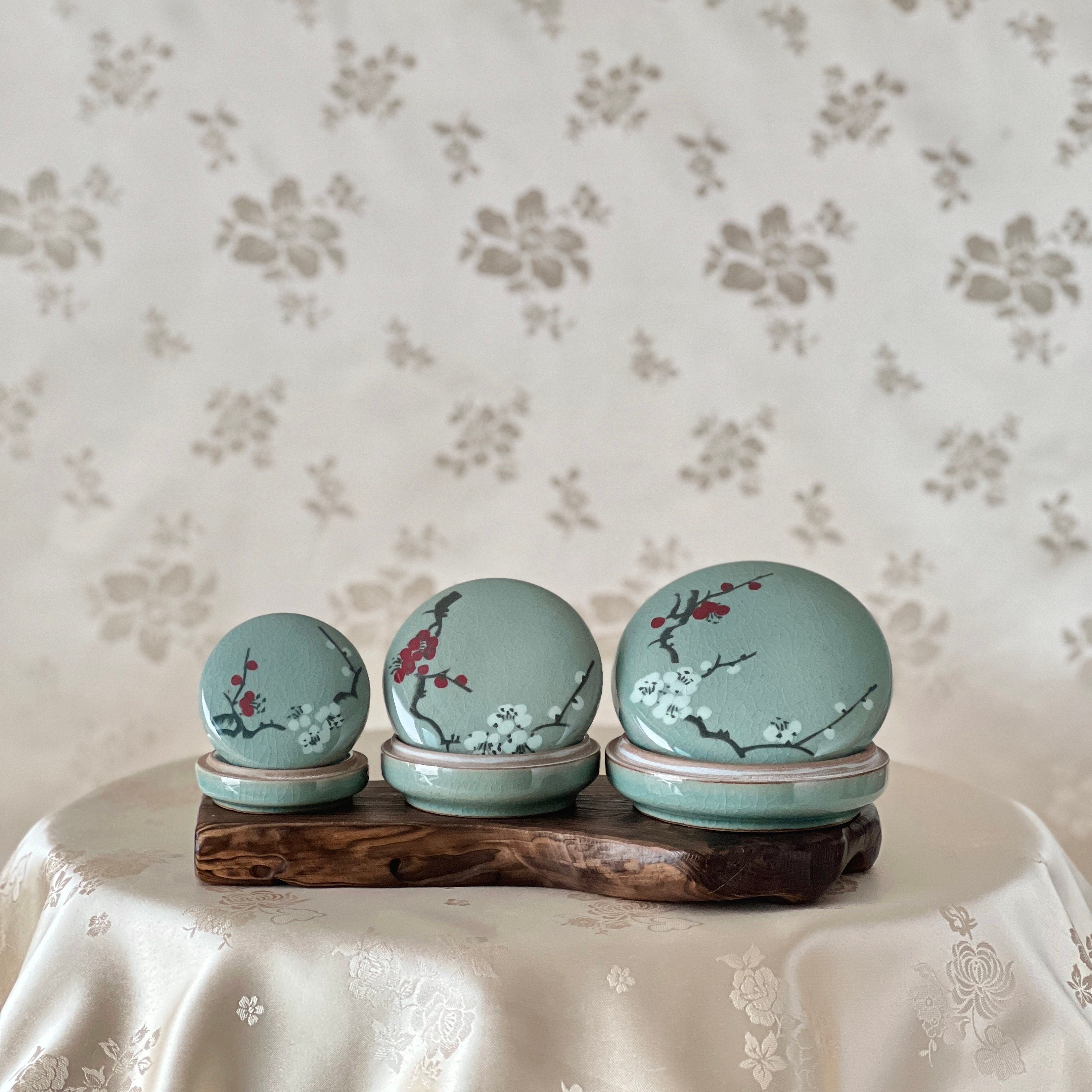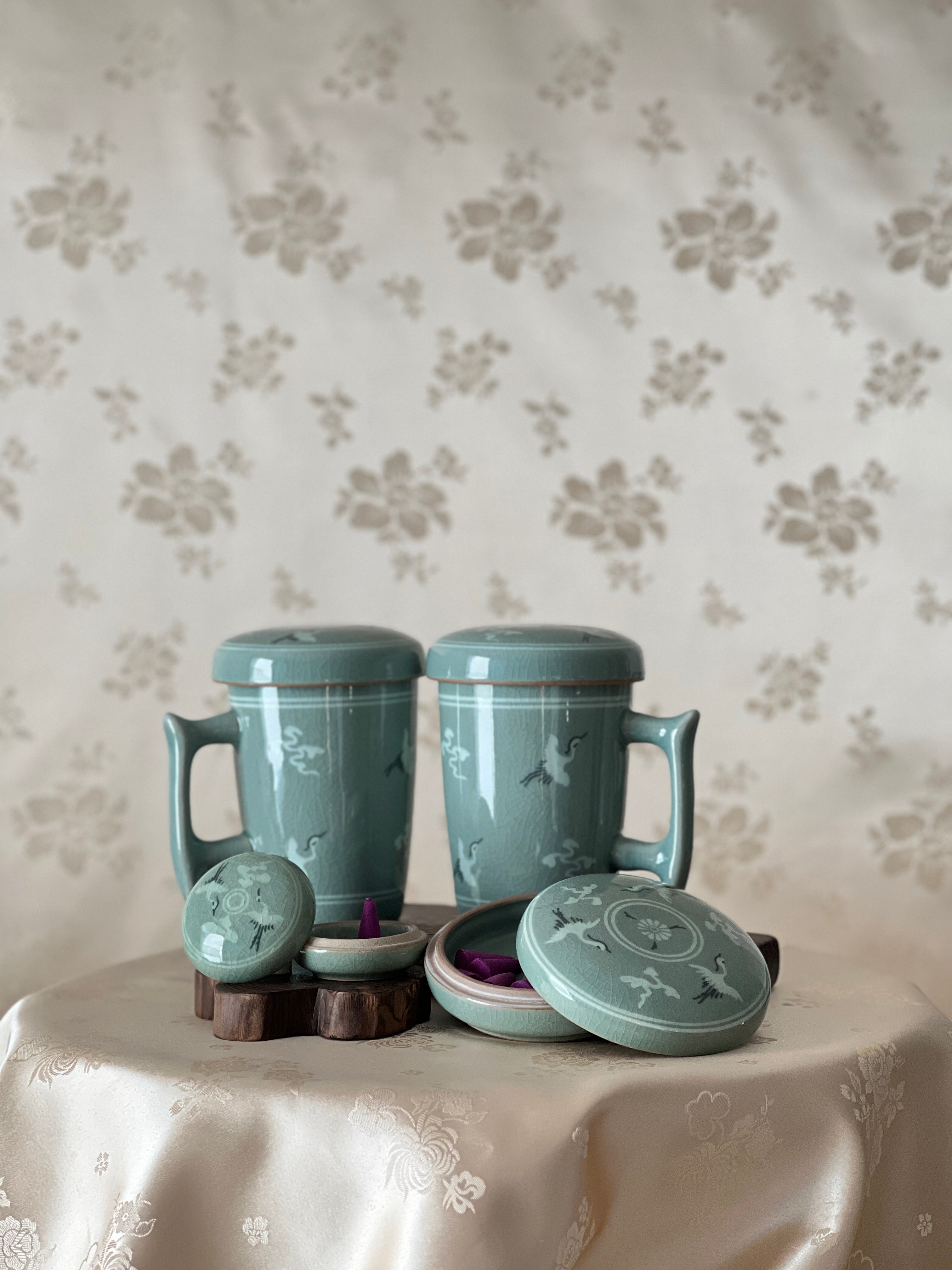


Celadon Large-Scale Openwork Vessel Trio: Peony Motif in White-Slip Sgraffito (Bakji)
- 世界網の積荷
- 在庫残りわずか - 2個のアイテムが残っています
- 途中の在庫
This trio is chosen by those who understand that harmony is often created not through sameness, but through the careful calibration of difference.
“Like three peonies unfolding at different tempos, the vessels gather, rise and open within the same field of celadon light.”
In this three-part composition by Icheon ceramic artist Lee Sang-bong, the peony is not treated as an ornamental motif placed upon finished form. It determines the very logic of the vessels. Blossom, leaf, open space and silhouette are brought into one structural system, so that the floral imagery appears to grow through the ceramic body rather than merely across it.
This distinction is essential to understanding the trio.
All three vessels share the same visual vocabulary, yet their bodies have been deliberately varied. One takes on the concentrated fullness of a flower bud, with the form drawing inward towards its upper edge. The tall central vessel introduces a markedly different vertical energy: its long neck rises above the surrounding bodies, creating an axis around which the other two forms appear to gather. The broader vessel expands laterally, giving greater weight to the lower register of the ensemble.
Seen together, the three establish a sequence of compression, ascent and expansion.
The composition was arranged in this way to prevent the trio from reading as three versions of one object. Instead, each vessel performs a different spatial role. The central piece raises the eye. The rounded companions hold it closer to the base. Their differing heights and widths create a triangular rhythm, while the shared colour, motif and pierced surfaces maintain unity.
The peony provides the symbolic and visual continuity that allows this asymmetry to feel resolved. In Korean culture, the peony has long carried associations of prosperity, dignity and abundance. Its layered petals naturally lend themselves to a form of representation in which fullness is central. Here, however, abundance does not mean simple visual excess. The artist has balanced dense floral surfaces with areas of absence, allowing the flower to be understood through what has been removed as much as through what remains.
Openwork therefore performs both a visual and structural function.
The pierced areas create darkness behind the celadon surface, introducing depth into an otherwise continuous ceramic wall. Leaves appear to overlap. Stems seem to pass behind blossoms. Petals move between surface and void. Because these openings are irregularly distributed according to the botanical composition rather than a repeated geometric grid, they give the vessels the impression of being inhabited by growing foliage.
Yet such apparent naturalness demands considerable calculation.
Every removed section reduces the continuous strength of the ceramic body. With works of this scale, the artist must maintain enough supporting material for the vessel to remain stable throughout drying and firing. The relation between pierced and unpierced areas therefore cannot be arbitrary. What looks organic must still obey structural discipline.
This tension between freedom and control is one of the trio’s most significant qualities. The leaves appear to spread naturally, but their arrangement has to protect the vessel. The peonies seem abundant, but their density must remain proportionate. Negative space feels spontaneous, yet it has to be calculated.
The bakji surface treatment extends this same tension into the skin of the object. After forming, white slip is applied over the ceramic body. The surface is then selectively scraped and worked so that the peony imagery becomes legible through contrast. The process asks for two qualities that are rarely separated in accomplished craft: meticulous precision and the courage to remove material decisively.
The white passages do not simply brighten the decoration. They alter the way the celadon itself is perceived. Against the pale floral areas, the blue-green ground appears deeper and more mineral. Against open perforations, it appears lighter and more translucent. The relationship between white slip, celadon glaze and interior shadow allows the same colour to perform differently across the surface.
Fine linear work further articulates the peonies. Petal veins and leaf structures have been drawn with restraint, giving definition without reducing the blossoms to illustration. Small reddish accents emerge intermittently through the foliage, introducing brief moments of warmth into an otherwise cool chromatic field. Because these points of colour are sparse, they function almost as pauses within the larger rhythm.
The rims deserve particular attention. None terminates in a severe horizontal line. Their slightly undulating edges recall the contour of flower petals, allowing the botanical subject to alter the architecture of the vessel itself. This is a small decision, but an important one: the peony is not confined to the decoration below. Its logic reaches the boundary of the form.
The three pieces also change one another through proximity. The compact body beside the tall vessel appears fuller because of the central vertical. The central neck feels more slender because it rises between broader masses. The widest body acts as a counterweight, restoring visual stability to the group.
This is why the trio should be read as a single spatial composition rather than three independent vessels accidentally brought together. Their individual proportions have meaning in relation to one another.
As the viewer moves around the group, that relationship continually alters. The tall form may temporarily conceal part of a rounded vessel. Openwork from one surface can align visually with the openings of another. Blossoms overlap across separate objects. At certain angles, the three bodies appear almost continuous; from others, the spaces between them become as important as the vessels themselves.
The empty space between the works thus performs a role similar to the pierced spaces within them.
Both create breath.
This correspondence gives the trio a particularly coherent character. Within each vessel, clay is balanced against absence. Across the ensemble, volume is balanced against interval. On the surface, white slip is balanced against celadon. In silhouette, rounded fullness is balanced against vertical ascent.
The work ultimately rests upon these relationships rather than on decorative abundance alone.
Lee Sang-bong’s trio transforms the peony from a motif into a structural principle: something that blossoms not only across the surface, but through form, void, proportion and grouping. The three vessels stand together with the quiet assurance of objects that do not need to match in order to belong to one another.
Their harmony lies precisely in their difference.
Dimensions
-
Height- 24cm (9.45 inch)
Diameter- 25cm (9.84 inch) -
Height- 36cm (14.71 inch)
Diameter- 20cm (7.87 inch) -
Height- 20cm (7.87 inch)
Diameter- 28cm (11.02 inch)
Related Links
世界中に発送いたします。以下は当社の配送ポリシーを構成する利用規約です。
発送処理時間
- すべての注文は、支払いの受領後 5 日以内に処理されることを目指しています。ご注文は土日祝日は発送されません。
- ご注文が集中した場合、発送が数日遅れる場合がございます。ご注文の発送が遅れる場合には、メールでご連絡させていただきます。
配送料と配送目安
- すべての注文は、K-Packet、航空便、EMS、速達宅配便 (UPS、Fedex、DHL など) で発送されます。
- ゆうパケット発送は基本的な発送サービスです。 K-Packet の推定配送時間は、お住まいの地域に応じて 14 ~ 21 日です。重量が2kgを超える場合はKパケット便から航空便に変更させていただきます。
- EMS の推定配送時間は、地域によって異なりますが、7 ~ 14 日です。航空便による配送方法は国によっては利用できない場合があることにご注意ください。
- 速達の推定配送時間は 5 ~ 10 日です。
- ご注文の送料はチェックアウト時に計算されて表示されます。
- 小包は可能な限り追跡されて発送され、注文が処理されると追跡番号が記載された自動メールが届きます。
私書箱への発送
- 私書箱に発送します
出荷確認と注文追跡
- ご注文の発送が完了すると、追跡番号が記載された発送確認メールが届きます。
損害賠償
- Artinko は、配送中の製品の破損または紛失については責任を負いません。受け取ったご注文が破損していた場合は、写真を撮ってできるだけ早くご連絡ください。解決できるよう努めます。
関税
- あなたの荷物は到着時にあなたの国の税関の対象となる場合がありますのでご了承ください。関税は受取人の責任となります。
- これらの料金については当社では管理できないことにご注意ください。現地の税関で荷物が長期間保留されている場合、配達時間が遅れる場合もあります。
配送に問題がある場合は、goryeo.artinko@gmail.com までメールをお送りください。