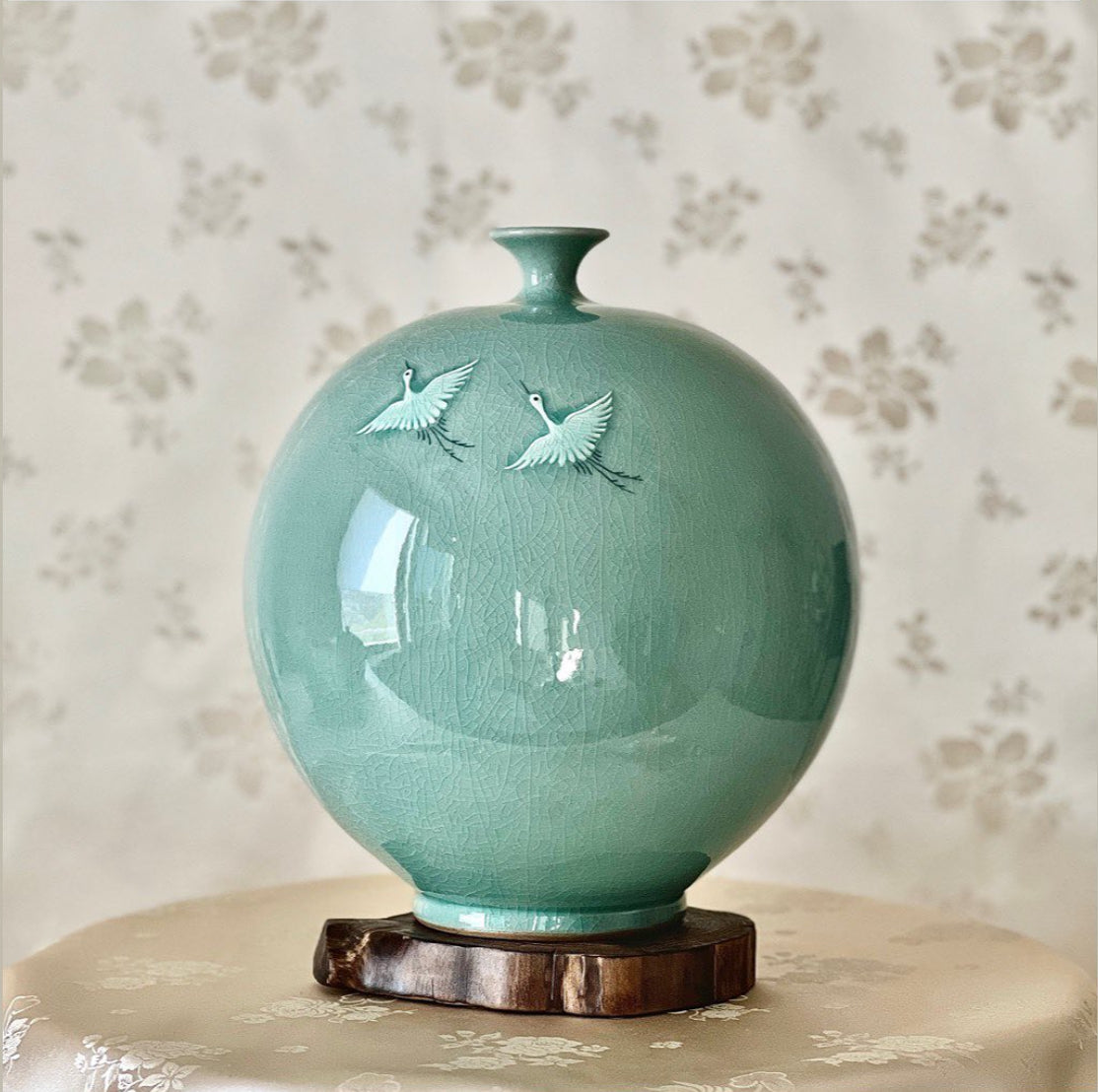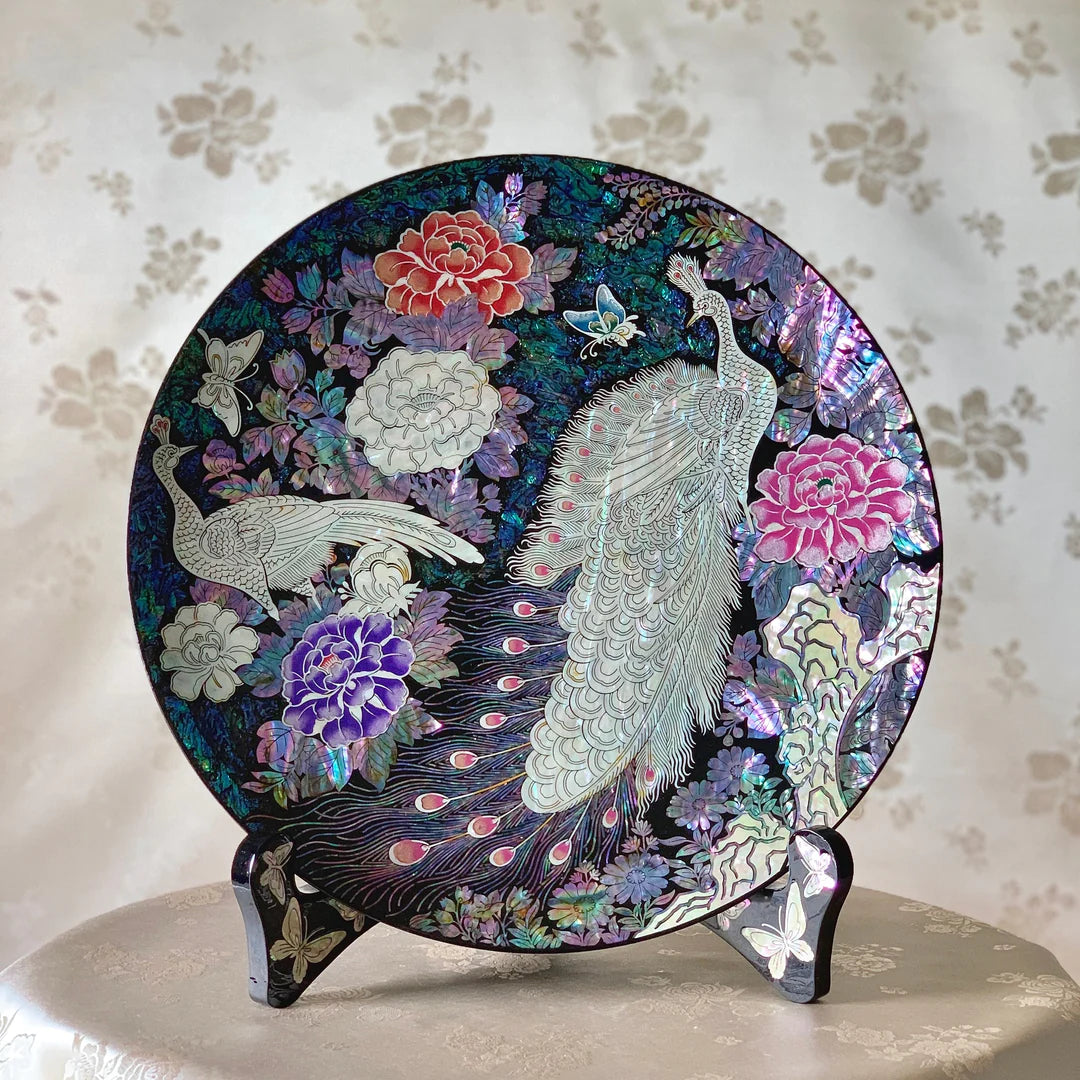


Celadon Long Vessel: Yeollimun Mixed-Clay Technique with Crane Motif, 2024
- 世界網の積荷
- 在庫残りわずか - 1個のアイテムが残っています
- 途中の在庫
This work is chosen by those who recognise that a traditional technique may remain alive only when it is allowed to move beyond repetition.
"Seven cranes rise diagonally across the vessel, as though the earth beneath them were gradually becoming sky."
Created in 2024 by Kim Yong Seop, an Icheon master ceramist, this long celadon Ho brings together the rare Yeollimun mixed-clay technique, a carefully ribbed surface, and seven cranes arranged in upward flight. Its significance lies not in any one of these elements independently, but in the way each has been composed to direct the viewer from density towards release.
Yeollimun begins before the vessel possesses its final shape. Differently coloured clays are brought together while retaining enough distinction for their separate tonal identities to remain visible. The resulting pattern resembles mineral veining, flowing water or shifting geological strata, yet none of these comparisons fully explains it. The pattern is not a picture of nature. It is the visible consequence of material being folded, compressed and reorganised.
This distinction is essential to the work. The surface does not imitate movement; it contains the physical record of movement.
Kim then places that material uncertainty under discipline through a dense sequence of vertical ribs. Repeated from foot towards shoulder, the carved channels impose a measurable structure over the changing mixed-clay pattern. Yet the two systems never coincide completely. The ribs remain regular while the clay beneath them shifts from dark to light, thick to thin, compressed to open. The vessel therefore holds two temporalities at once: the unpredictability of material formation and the repeated rhythm of deliberate carving.
Its elongated form further clarifies this tension. A more rounded jar tends to return the gaze towards its centre. Here, the higher oval body encourages the eye to travel. The narrow lower section expands steadily before turning inward near the shoulder, so that the form possesses both grounded weight and upward direction. The small mouth does not dominate the silhouette; instead, it acts almost as the final point of a long vertical gathering.
The seven cranes extend this movement beyond the structure of the vessel itself. They do not form a level procession. Instead, they are distributed diagonally, rising towards the upper left in successive stages. Some occupy the lower zones of the body, others appear higher towards the shoulder, so that the composition reads as an ascent rather than a repeated motif.
This arrangement is particularly effective because it resists symmetry. Had the birds been placed evenly around the centre, the vessel would have become more emblematic and static. Their diagonal progression introduces direction. The viewer instinctively follows the sequence upward, moving from one crane to the next. In this sense, the cranes do not simply inhabit the vessel; they organise the act of looking.
Within Korean visual culture, cranes have long carried associations of longevity, nobility, spiritual refinement and the meeting of earthly and celestial realms. Their meaning here is strengthened by posture. These are not cranes standing beside water or resting within landscape. They are cranes in flight. The symbolic language therefore shifts from endurance alone towards elevation.
The presence of seven birds adds another layer, but one that should remain interpretively measured. Seven may be understood in broader symbolic traditions as a number associated with completeness or a fulfilled sequence. Without an explicit statement from the maker, it would be too definite to assign the number a single historical Korean meaning. More convincing is the visual evidence: seven provides enough repetition for flight to become progression. One crane might be an image; seven become a movement.
This is why the relationship between number, crane and ascent feels coherent. The seven birds establish rhythm, the crane introduces the cultural language of longevity and elevated spirit, and the diagonal direction converts those meanings into physical movement. The work does not state prosperity or transcendence literally. It allows them to emerge through composition.
The celadon glaze holds the entire structure within a subdued blue-green atmosphere. It softens the contrast between the mixed clays without erasing their complexity, while reflections gather strongly along the carved ribs. As the vessel is turned, dark passages appear to deepen and dissolve, and cranes that were previously hidden enter the field of vision. No single viewpoint gives a complete reading.
This circumferential experience is important. The work asks the viewer to move around it, and in doing so to reconstruct the ascent gradually. One encounters a crane, then another, then a shifting band of mixed clay, then another bird at a higher level. Looking becomes sequential. The physical act of circling the vessel begins to echo the temporal process by which it was made.
The work therefore reaches beyond the preservation of Yeollimun as a rare technique. Kim Yong Seop uses the technique as a material ground upon which another idea can unfold. The clay carries the memory of earth under pressure; the ribs bring that movement into order; the cranes release the composition upward.
What remains is a distinctly Korean meditation on control without rigidity. The vessel begins with mixed earth, submits that earth to structure, and finally allows seven cranes to rise across it. Material becomes rhythm, rhythm becomes flight, and the weight of clay is made to imagine the sky.
Dimension
- Diameter- 23cm (9.05 inch)
- Height- 32cm (12.6 inch)
Related Links
世界中に発送いたします。以下は当社の配送ポリシーを構成する利用規約です。
発送処理時間
- すべての注文は、支払いの受領後 5 日以内に処理されることを目指しています。ご注文は土日祝日は発送されません。
- ご注文が集中した場合、発送が数日遅れる場合がございます。ご注文の発送が遅れる場合には、メールでご連絡させていただきます。
配送料と配送目安
- すべての注文は、K-Packet、航空便、EMS、速達宅配便 (UPS、Fedex、DHL など) で発送されます。
- ゆうパケット発送は基本的な発送サービスです。 K-Packet の推定配送時間は、お住まいの地域に応じて 14 ~ 21 日です。重量が2kgを超える場合はKパケット便から航空便に変更させていただきます。
- EMS の推定配送時間は、地域によって異なりますが、7 ~ 14 日です。航空便による配送方法は国によっては利用できない場合があることにご注意ください。
- 速達の推定配送時間は 5 ~ 10 日です。
- ご注文の送料はチェックアウト時に計算されて表示されます。
- 小包は可能な限り追跡されて発送され、注文が処理されると追跡番号が記載された自動メールが届きます。
私書箱への発送
- 私書箱に発送します
出荷確認と注文追跡
- ご注文の発送が完了すると、追跡番号が記載された発送確認メールが届きます。
損害賠償
- Artinko は、配送中の製品の破損または紛失については責任を負いません。受け取ったご注文が破損していた場合は、写真を撮ってできるだけ早くご連絡ください。解決できるよう努めます。
関税
- あなたの荷物は到着時にあなたの国の税関の対象となる場合がありますのでご了承ください。関税は受取人の責任となります。
- これらの料金については当社では管理できないことにご注意ください。現地の税関で荷物が長期間保留されている場合、配達時間が遅れる場合もあります。
配送に問題がある場合は、goryeo.artinko@gmail.com までメールをお送りください。