Box for Sale! The Wedding Chest That Marched Through Joseon Korea

Sarangchae Journal · Joseon wedding customs
The Wedding Chest
and the village that carried it
◆ ◆ ◆
Picture a Joseon village at dusk. A band of young men comes up the lane in a noisy, swaggering pack. One of them is bent under a low wooden chest wrapped in red and blue silk, his face hidden behind a mask of dried squid. And all of them are shouting at the top of their lungs:
“Box for sale! A box for sale!”
Every light in the bride’s house has been turned on. Everyone knows what is coming. A wedding is days away, and the groom’s friends have arrived with the ham, the wedding chest. Getting it through the front door is going to cost the bride’s family.
This week the journal follows that chest, because it is one of the most theatrical objects in Korean tradition, and because it is the ancestor of something new on our shelves.
A Gift You Had to Haggle For
The ham was the groom’s family’s formal gift to the bride’s family, sent a few days before the wedding. Delivering it was a piece of street theatre. Here is how the evening unfolded:
- 1The lights go onThe procession arrives in the evening, and the bride’s house is lit up to meet it.
- 2Pay per stepThe bride’s friends offered money for every step the men took toward the house, and the men refused to budge until they were paid.
- 3Mask and bowlThe carrier wore the squid mask and was asked to smash a wooden bowl, both gestures meant to scare off evil spirits.
- 4The rice cake seatInside, the chest was set on steamed rice cake dusted with red bean, another charm against misfortune. The bride’s father inspected the contents while the bride waited out of sight in her room.
- 5Then, a feastEveryone ate and drank together, groom’s friends included. A marriage had been announced to the whole neighborhood, and it was a party.
In Joseon, the wedding itself took place at the bride’s house, so all of this unfolded at her door.
Inside the Box
The chest was a small, carefully composed argument about what a marriage should be. Accounts vary by region and household, but the usual contents were:
Honseo
A marriage letter
Wrapped in black silk, in which the groom’s side formally thanked the bride’s parents.
Chaedan
Red and blue silk
To be made into clothing. Red cloth was tied with blue thread and blue with red, so each color carried the other.
Five pouches
Grain and seed
Tied with red and blue string. Red beans in a red bag turned away misfortune. Glutinous rice in a blue bag was the hope of growing old together.
Yemul
Jewelry and presents
Whatever the groom’s family could afford. In Joseon, how lavish the box was told everyone how powerful the family was.
There was even a fortune-telling game in some households. The bride’s mother reached in and drew out a bolt of cloth, and if it was the red one, wrapped in blue paper, it was said the couple would have a son.
And then there is the outside of the chest. Wrapped in red and blue silk, the ham carried the harmony of yin and yang through the village. Red belonged to the bride and blue to the groom, and the whole box was a way of saying the two would be knotted together.
If that sounds familiar, it should. A few weeks ago we wrote about the bojagi, the wrapping cloth that turns a gift into a wish. The ham is the same idea at full scale, with a chest for a gift, a procession for a bow and an entire village for a recipient.
The Rest of the Wedding, in Four Objects
The chest was only the opening act. Four more objects carried the rest of a Joseon wedding.
Kirogi
The wooden goose
On the wedding day, the groom presented a goose as a promise of fidelity, because geese mate for life. Early on the bird was alive, but by the late Joseon period a carved wooden one was usually substituted. It was carried wrapped in cloth, and the groom knelt, set it on a table and bowed twice. One surviving goose in the Metropolitan Museum was carved from a single piece of wood, with the head and neck cut separately, and its eyes picked out by dark spots in the grain.
The groom’s robe
Borrowed rank
For one day, the groom wore the dress of an official. Even a commoner could marry in clothing normally reserved for the elite. It is the same logic as the hyungbae we looked at last week, in which cloth announced who you were meant to be.
Daeryesang
The ceremony table
Between the couple stood rice wine, rice cakes, chestnuts and jujubes, a pine branch and a bamboo branch for fidelity, and a red candle and a blue candle. Even the live rooster and hen were wrapped in red and blue cloth. The couple bowed to each other and shared wine from a gourd cup.
Pyebaek
The skirt
At the bride’s formal greeting to her new family, the groom’s parents threw chestnuts and jujubes at her, and she caught them in her skirt. Every one she caught was a wish for a child.
New in the gallery
From Marriage Chest to Jewelry Chest
Today, the descendants of the ham live on dressers and bedside tables rather than in village lanes. The traditional ham was a low, wide box, roughly the size of a small trunk, with a hinged lid, thin pine or paulownia boards and brass fittings. It was usually finished in red or black lacquer.
Our new Mother-of-Pearl Wedding Jewelry Chest: Longevity Motifs by the artisan Jang Tae-bok shrinks that silhouette to jewelry scale and keeps the architecture: a low body, a gently pitched lid like a tiled roof, and spreading feet that lift the whole thing off the table.
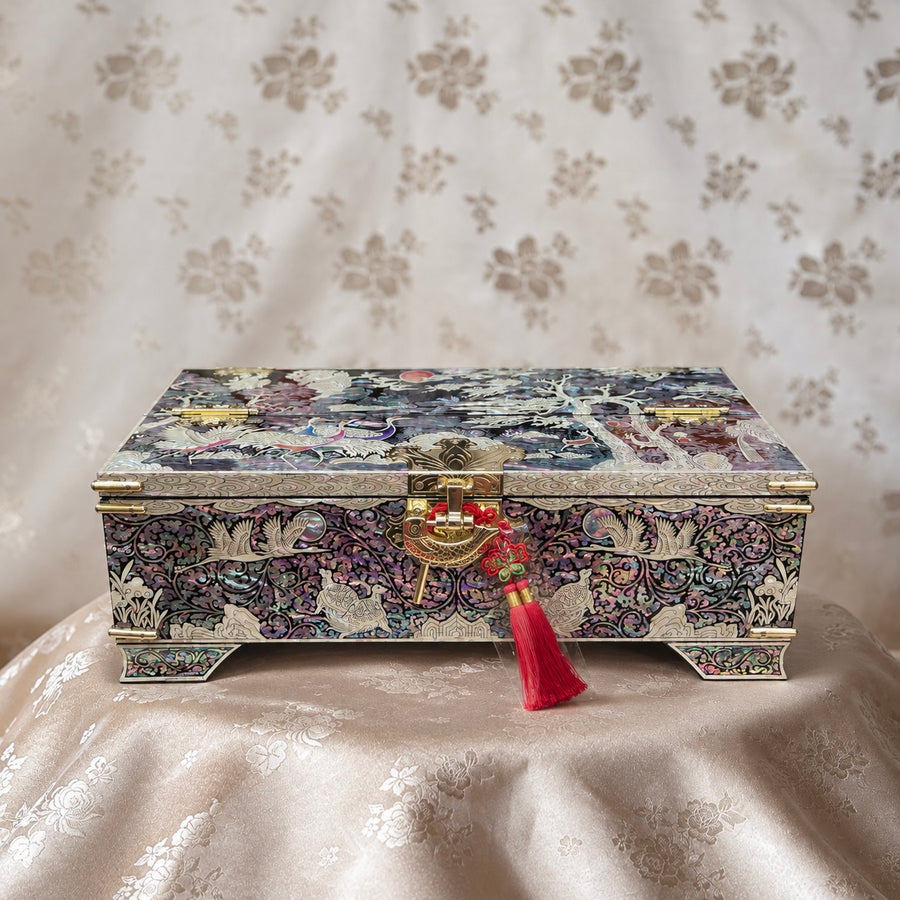
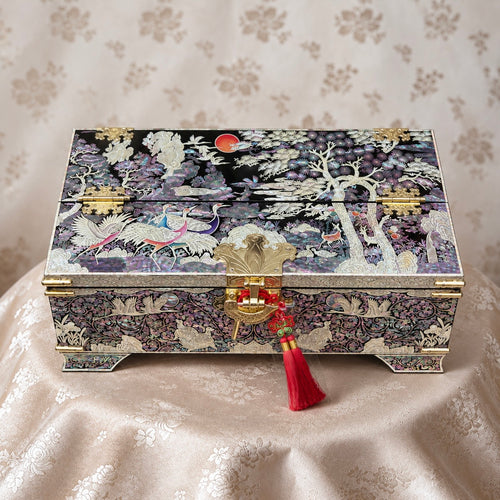
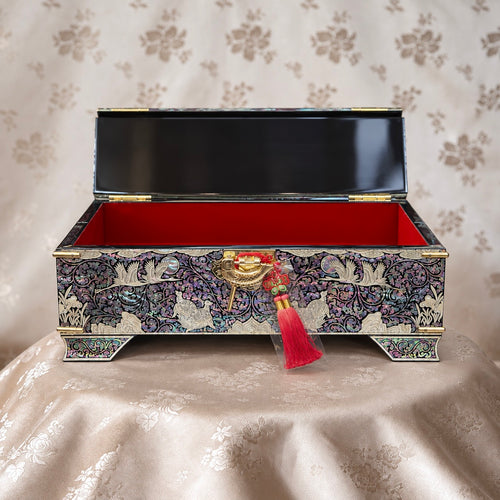
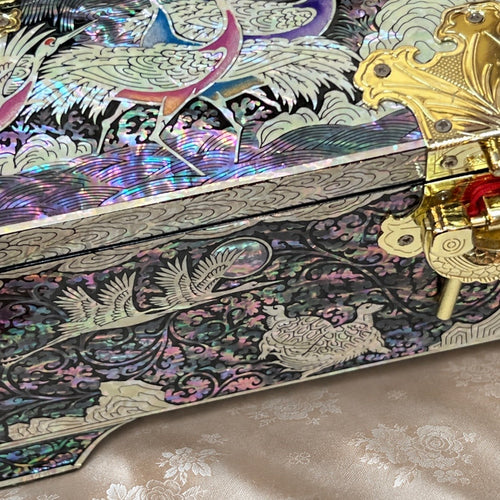
The design is where it earns the word exceptional. Across the lid, pine branches stretch from edge to edge, cranes change the direction of the eye, and a single red sun sits among rocks and clouds. Around the body the scene keeps changing: cranes and turtles on the front, deer on the back, pines and birds along the sides. Walk around it and you meet a different composition at every turn. Together they are Korea’s classic repertoire of long life, and on a wedding chest the wish becomes one for shared duration: long life, together.
The shell itself is alive. The black lacquer ground shows between the pieces, and the iridescent mother-of-pearl shifts violet, green and blue with the light, so the pale birds and animals stay legible while the scrollwork around them glimmers. A gold-toned fish-shaped lock, a knotted ornament and a red tassel sit at the center. They mark the moment where looking becomes opening.
And open it. Inside is a broad red chamber, and under the red lacquer on the floor lies sambe, traditional Korean hemp cloth, its weave still visible through the finish. Red was the bride’s color. The chest is built so that the part you see only when you lift the lid is the part with the most feeling.
We want to be clear about what this is. It is a contemporary work made by a living artisan, not an antique ham, and it is sized for jewelry rather than a groom’s whole offering. What it keeps from its ancestor is the grammar: auspicious imagery on the outside, a red heart on the inside, and the belief that the container is part of the gift.
Five Ways to Give a Wish This Season
The holidays are a giving season, and the ham reminds us what the best gifts do. They say what you hope for the person, out loud, in a form they can keep. Here is how we would choose, in the spirit of the wooden goose and the chest:
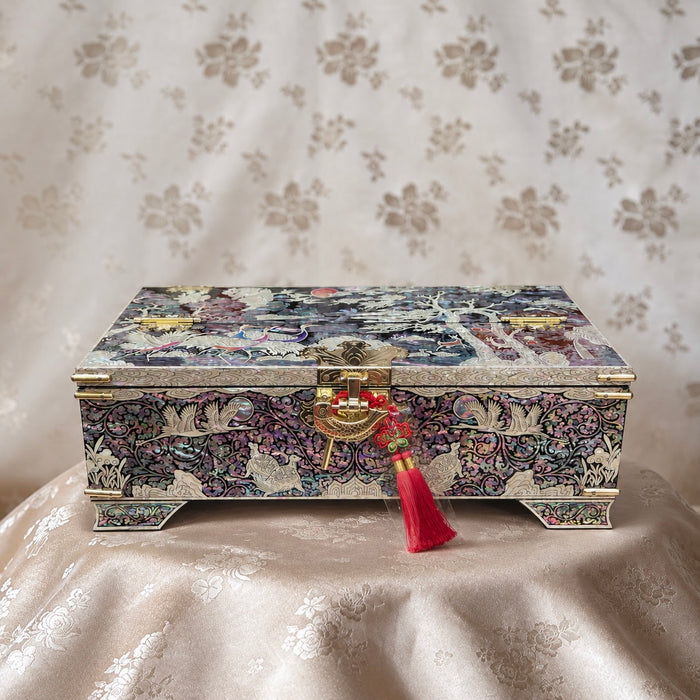
The whole story
Wedding Jewelry Chest: Longevity Motifs
For an engagement, a wedding, a milestone anniversary, or anyone who keeps things that matter.
Shop this chest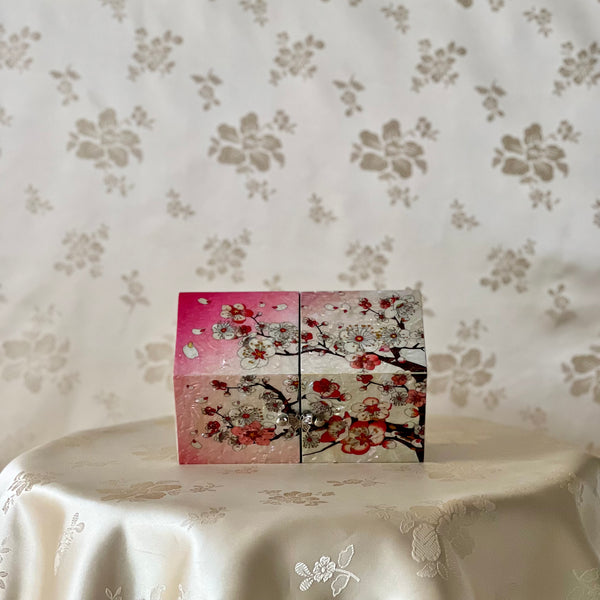
The pair
Plum Blossom Jewelry Chest Pair
The wooden geese always came as a pair. Two small chests suit a couple, or two sisters, or a parent and a grown child, with one for each.
Shop the pair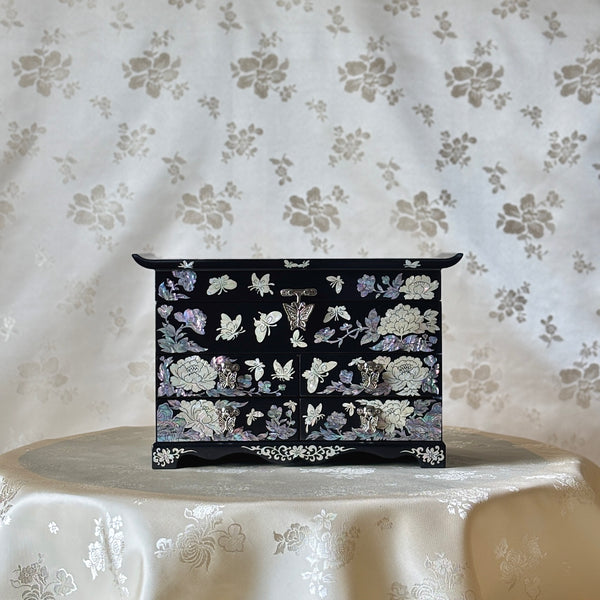
The scholar’s desk
Butterfly & Peony Chest, Scholar’s Desk Form
Shaped like the low writing table of the sarangbang, our namesake room. A good fit for a reader, a writer, or a student putting in the hours.
Shop this chest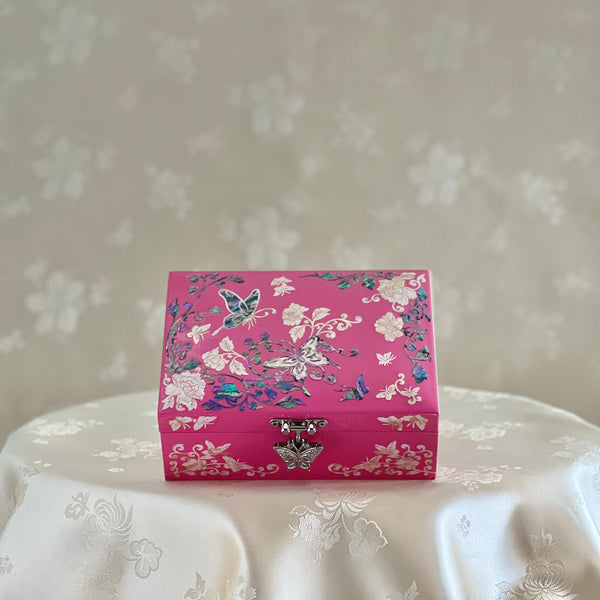
The small wish
Pink Butterfly & Peony Jewelry Box
About the size of a palm, so it suits a stocking, a host gift, or a teacher. The butterfly is a traditional symbol of joy and the peony of wealth and honor.
Shop this box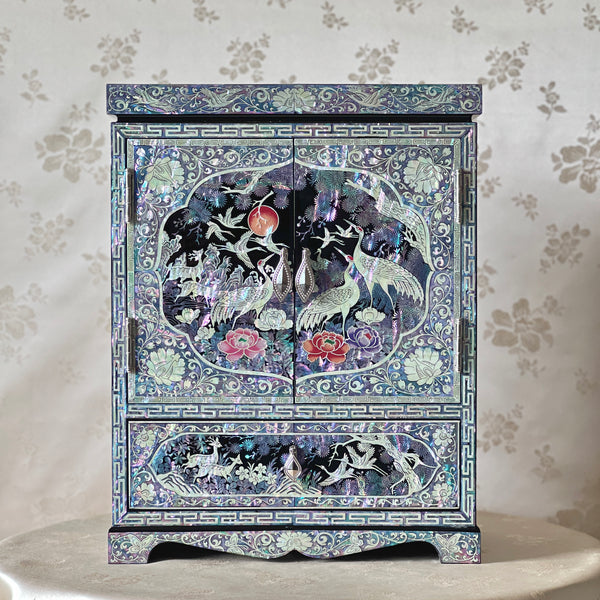
The heirloom
Grand Double-Door Chest, Ten Symbols of Longevity
The one that gets passed down, for the person who will still be telling its story in thirty years.
Shop the heirloomAnd for the coffee drinker on your list, the Mother-of-Pearl Mug with Crane and Pine brings the same long-life symbols into a daily ritual.
Wrap It Like a Joseon Groom
Three habits worth stealing from the ham:
Next week
We keep mentioning red and blue, and that is no accident. Both belong to a five-color system that runs through Korean cloth, architecture and ceremony: obangsaek. Next week, we promise, we meet all five.
Until then — give something worth haggling for.