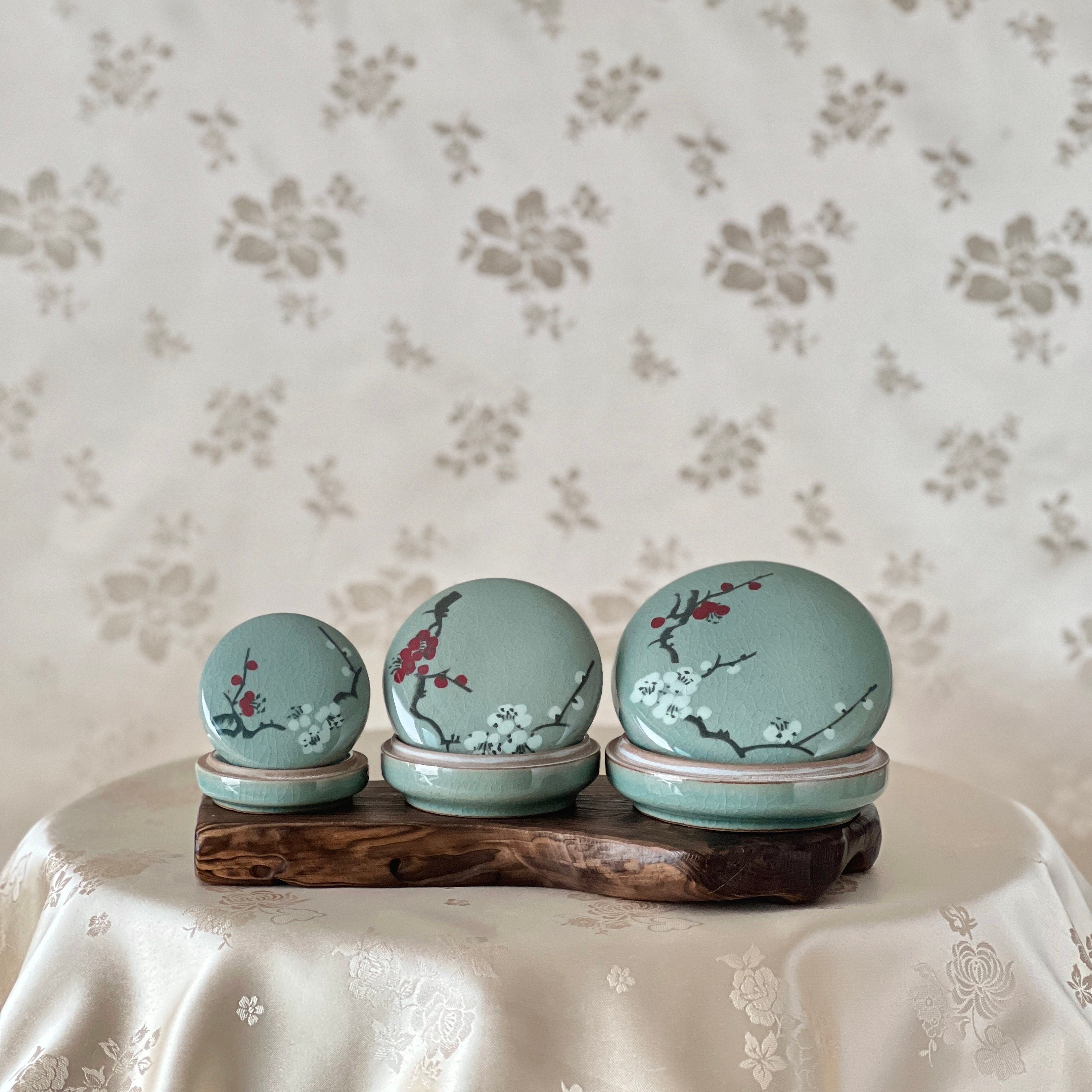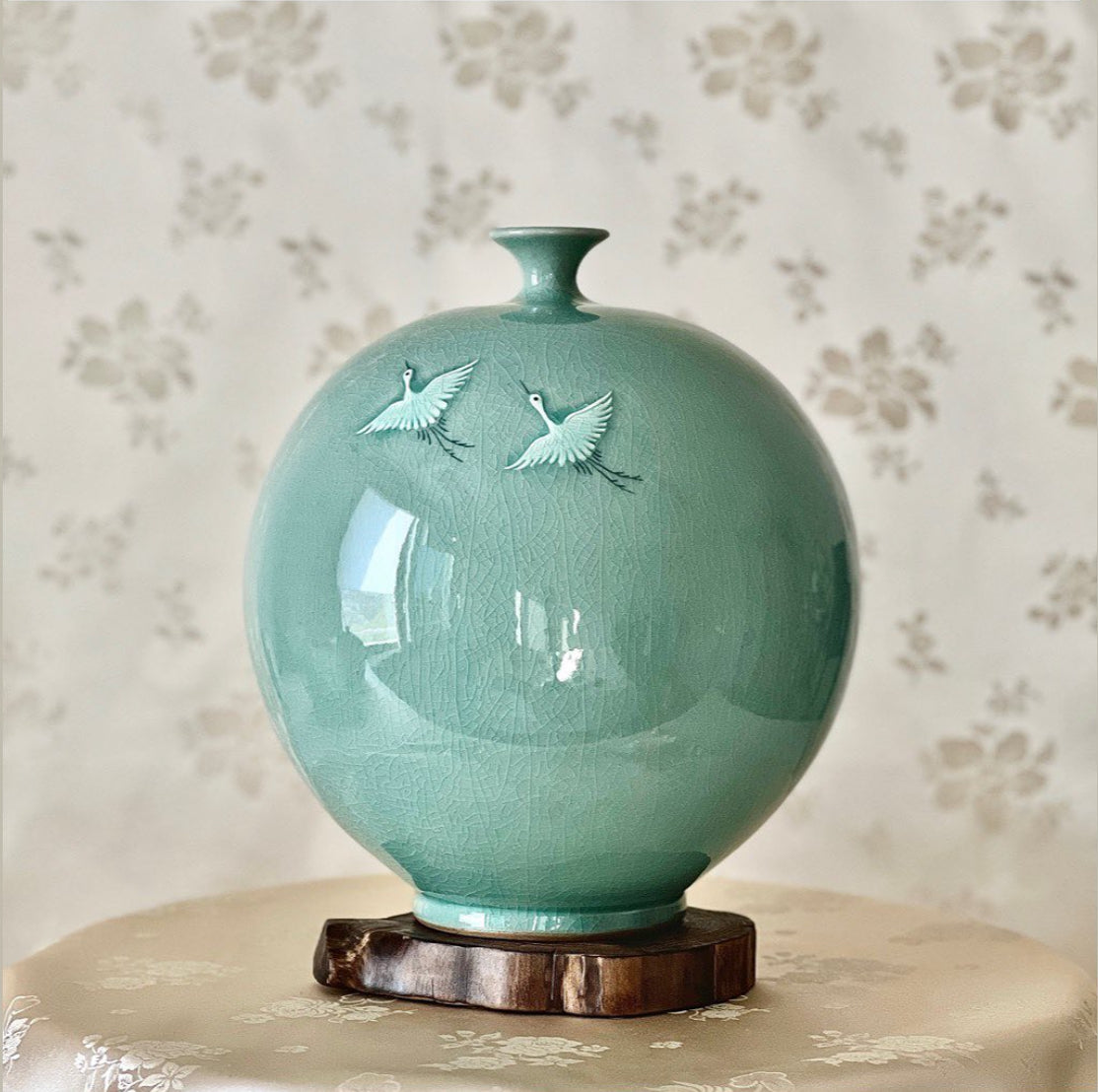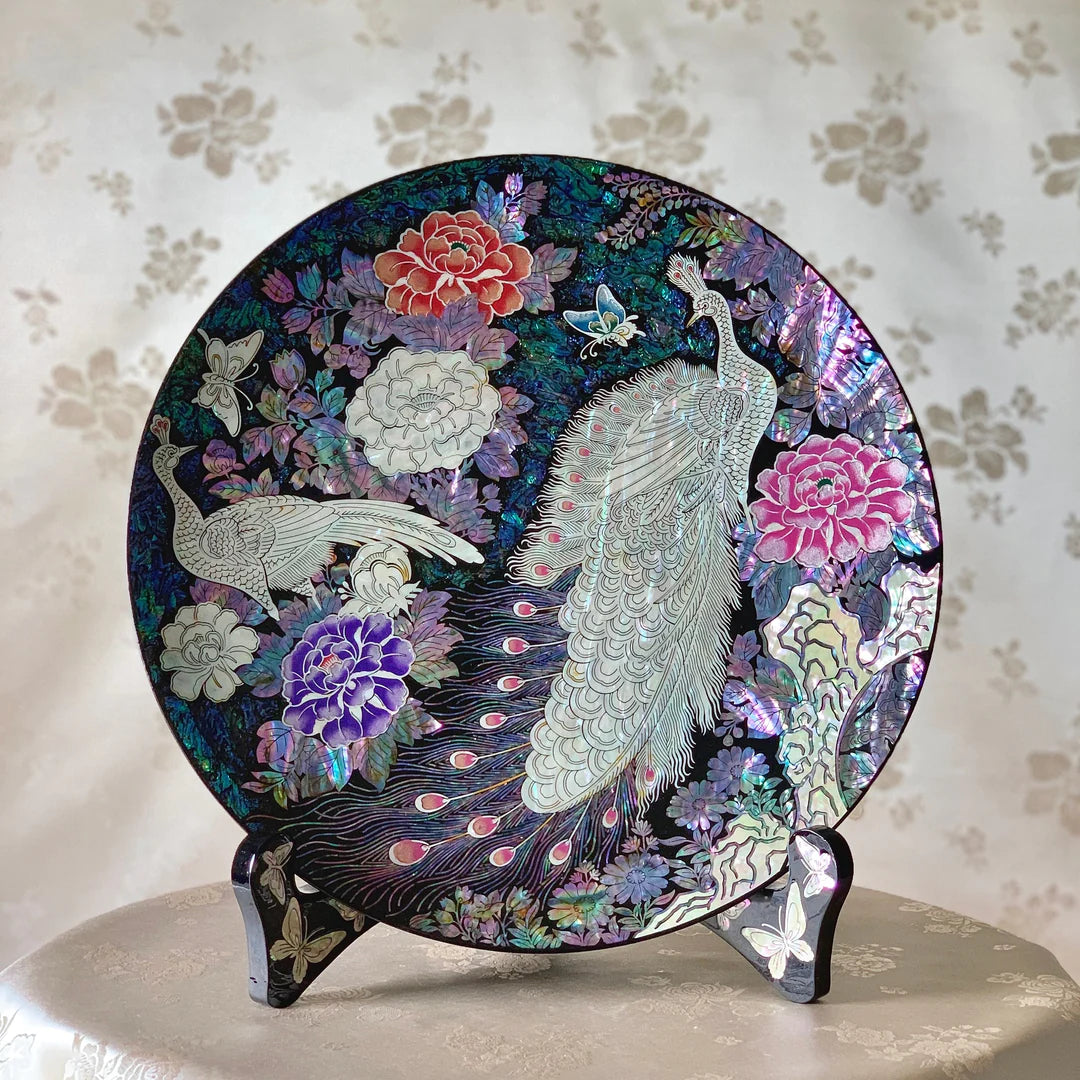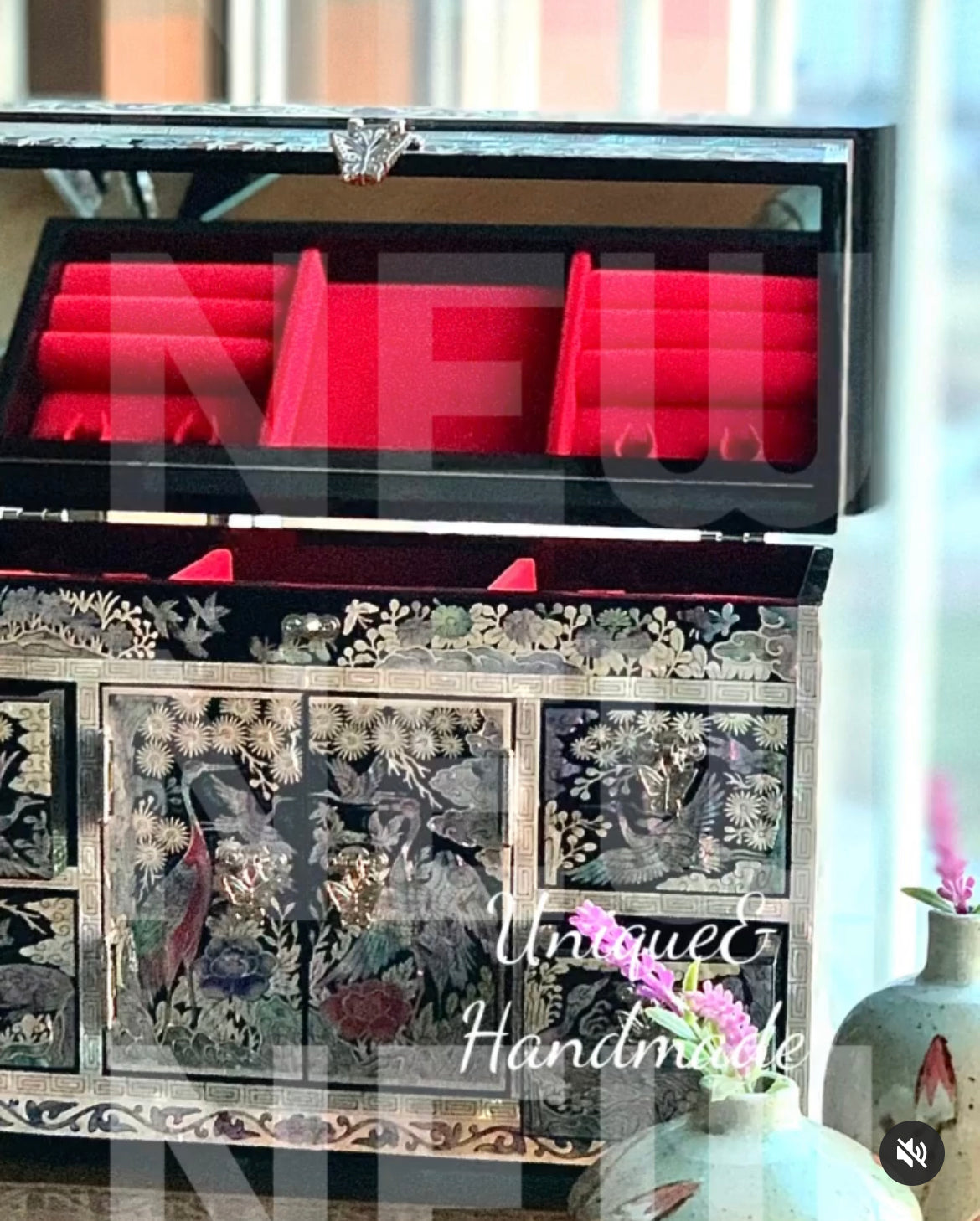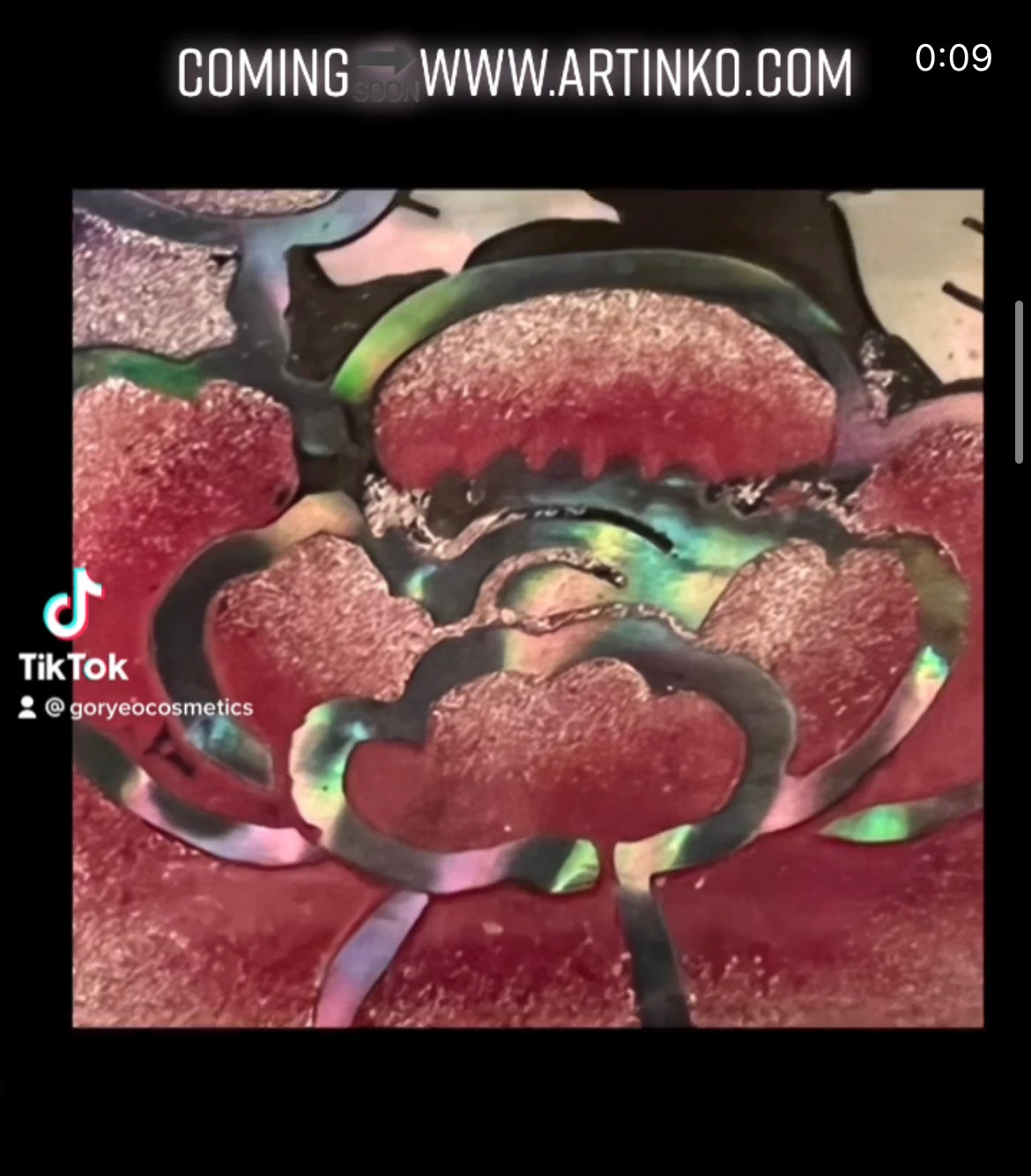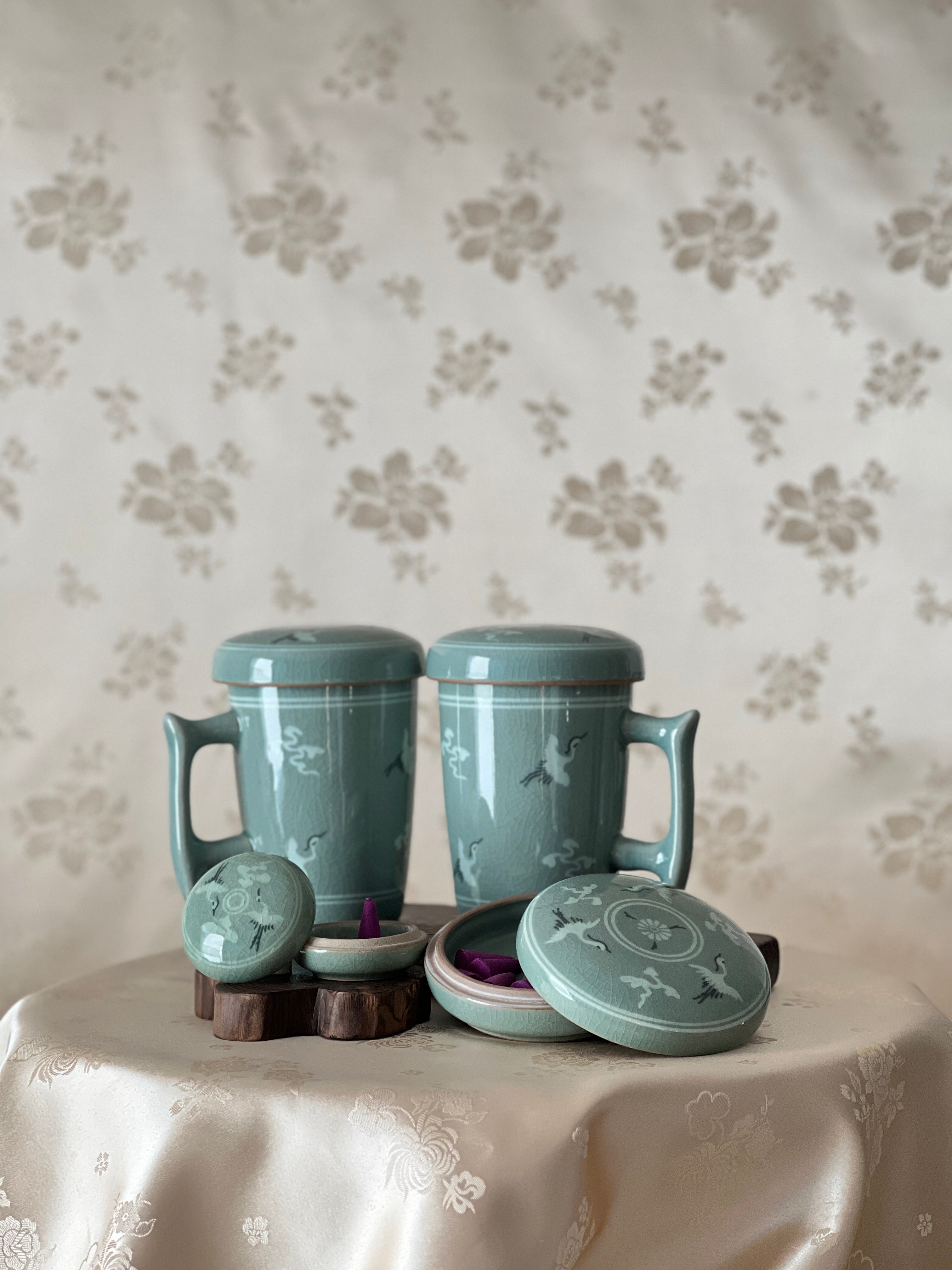


Celadon Vase Set: Sgraffito (Bakji) Peony Motif with Incised Turtle Shell Ground
- Worldwide Shipping
- Low stock - 1 item left
- Backordered, shipping soon
This set is chosen by those who recognise that complexity becomes most persuasive when it is held in restraint.
“The surface does not announce itself at once; it unfolds like something remembered slowly.”
This vase set by Lee Sang-bong is structured as a dialogue between two traditional vessel types whose volumes are intentionally displaced. In the maebyeong, the upper body broadens into a poised fullness before narrowing towards the foot and neck, giving the form a lifted, almost inhaled quality. In the jubyeong, by contrast, the lower body bears more of the visual weight, so that the vessel rises from grounded fullness into a quieter shoulder and mouth. The pair is therefore not merely matched, but calibrated: one form gathers the eye upwards, the other settles it downward. Together, they establish a measured alternation between elevation and gravity.
This distinction in profile matters because the ornamental composition has been adapted to each body rather than simply transferred onto it. The peony branches do not sit on the vessels as surface embellishment. They are arranged to move with the turning of the clay, expanding across the fuller zones and narrowing where the forms constrict. On the maebyeong, the floral spread appears to bloom outward around the upper swell, reinforcing the vessel’s buoyant volume. On the jubyeong, the main cluster sits lower and broader, echoing the body’s weight-bearing centre. Composition here follows structure; the decoration has been made to inhabit the vessel’s anatomy.
The bakji method is central to this effect. By applying both white and black slip, then cutting back the surrounding areas so that selected forms remain with precision, the artist creates a surface in which image and ground are separated through labour rather than outline alone. The dark peony leaves and branches possess a cut clarity that gives the composition its armature. Against them, the blossoms appear softer and more expansive, their pale petals opening in layered intervals. Small red accents in the stamens and parts of the petals interrupt the cool tonality with restraint, preventing the floral imagery from becoming diffuse. These touches are not decorative excess; they act as points of animation, drawing the eye briefly inward before releasing it again across the wider surface.
The choice of peony is also culturally deliberate. In Korean decorative tradition, the peony carries associations of abundance, dignity, and cultivated prosperity. Yet here it is not presented in a crowded or overtly celebratory way. Instead, the blossoms are held within a disciplined system of leaves, stems, and intervals, so that prosperity is expressed not as excess, but as mature fullness under control. This is a particularly effective reading for celadon, whose quiet chromatic range favours depth over brilliance.
Equally important is the incised turtle-shell ground that fills the remaining field. Once the principal floral elements have been established, the rest of the surface is not left empty. It is carefully articulated with a repeated geometric network, then marked again with small white dots placed within each section. This background does several things at once. Visually, it prevents the floral imagery from floating without structure. Symbolically, the turtle-shell pattern evokes endurance and protection, lending the surface a stabilising undercurrent beneath the peony’s more expansive associations. Rhythmically, the repetition of the incised units introduces a quiet pulse that counterbalances the freer movement of the branches.
This interplay between floral abundance and geometric containment is where the set becomes especially compelling. The viewer first encounters the blossoms, but remains with the work because of the ground. The peonies offer immediate presence; the incised field reveals the artist’s patience, control, and willingness to undertake a demanding surface logic across the whole form. The white dots intensify this impression. They are small gestures, but repeated without negligence, and they transform the background from a secondary device into an active participant in the visual order.
What finally emerges is a set that rewards repeated viewing through its distribution of attention. Form directs ornament; ornament clarifies form. The paired profiles create difference without discord, while the bakji carving and incised ground reveal a maker willing to pursue intricacy without losing composure. These vessels do not treat beauty as display. They present it as something built through discipline, structure, and a sustained confidence in slow looking.
Dimensions
- Mae Byeong
Height- 36 cm (14.17 inch)
Diameter- 20 cm (7.87 inch) - Ju ByeongHeight- 36 cm (14.17 inch)
Diameter- 20cm (7.87 inch)
Related Links
We ship worldwide. Following are the terms and conditions that constitute our Shipping Policy.
Artinko Products: Care and Authenticity
All information supplied through the Site is for informational purposes regarding the history and care of traditional Korean crafts. While we guarantee 100% authentic materials, Artinko is not responsible for damage caused by improper handling, such as using non-food-safe decorative items for dining or using harsh chemicals on delicate Mother-of-Pearl surfaces.
Section 13: Our Delivery Guarantee
Unlike standard templates, Artinko takes full responsibility for your order until it is safely in your hands. We understand the fragile nature of traditional Korean ceramics and lacquerware. In the rare event that an item is damaged or lost during transit, we will resend the item at no extra cost to you or issue a full refund immediately upon verification of the damage.
Returns & Refunds
-
14-Day Return Policy: Merchandise can be returned or exchanged within 14 days of receipt if the product has not been opened or used and remains in its original packaging.
-
Process: To start a return or report a shipping issue, please contact us at contact@artinko.com.
-
Exchanges: We only replace items if they are defective or damaged.
Shipment processing time
- All orders are aimed to be processed within 5 days after receipt of payment. Orders are not shipped on weekends and holidays.
- If we are experiencing a high volume of orders, shipments may be delayed by a few days. We will contact you by email if there is some delay in shipment of your order.
Shipping rates and delivery estimates
- All orders are shipped by K-Packet, Air mail, EMS, Express Courier (UPS, Fedex, DHL Etc).
- K-Packet shipping is basic shipping service. K-Packet estimated shipping time is 14-21 days, depending on your region. If weight is over 2kg, K-packet service would be converted to Air Mail.
- EMS estimated shipping time is 7-14 days, depending on your region. Please note that Air Mail shipping method may not be available for all countries.
- Express Courier estimated shipping time is 5-10 days.
- Shipping charges for your order will be calculated and displayed at checkout.
- Parcels are sent tracked where possible, and you will receive an automated email with a tracking number once your order is processed.
Shipment to P.O. boxes
- We do ship to P.O. boxes
Shipment confirmation and Order tracking
- You will receive a shipment confirmation email with a tracking number once your order has been shipped.
Damages
- We pack our items with extreme care to ensure they survive the journey. In the rare event of damage, contact us immediately with a photo and we will work with you to find a solution.
Customs duty
- Please note that your parcel may be subjected to the customs of your country when it arrived in. And the customs duty is the recipient’s responsibility. USA customers only: we pay your customs fee!
- Please note we have no control over these fees. Delivery time may also be delayed if local customs have your package on hold for a long period of time.
If you have problems with delivery, please send us an email to contact@artinko.com