Meet the master: 이영옥 명장 — Craftsmaster Lee Young-ok

The Woman Who Taught Pearl to Shine in Color
A portrait of Lee Young-ok — mother-of-pearl master, inventor, and keeper of a three-generation legacy.
There are craftspeople who inherit a skill, and there are those who are born into it so completely that it becomes impossible to tell where the craft ends and the person begins. Lee Young-ok — known formally as Craftsmaster Lee Young-ok (이영옥 명장)— belongs firmly to the second kind. She didn't choose mother-of-pearl. It chose her, from the very first moment she saw light fracture through an abalone shell in her parents' workshop as a little girl.
Today she is one of South Korea's most decorated traditional artisans, the CEO of her brand Jinjooshell (진주쉘), an inventor with multiple patents, and a living bridge between an ancient craft tradition and the modern world. But none of that tells you who she actually is. For that, you have to go back to the beginning.
ORIGINS
Born Into the Shimmer
Lee Young-ok grew up surrounded by shells. Her father and mother both worked in the mother-of-pearl industry, and her maternal uncles processed abalone shells in Busan, the great southern port city of Korea. The family home wasn't just a home — it was a workshop, a supply chain, and a school rolled into one.
Of six siblings, she was the only one who stayed close to the work. While others kept their distance from the repetitive labour of sandpapering and varnishing, Young-ok was drawn in. "I was fascinated by the shimmer," she has said, "and happy to touch those beautiful shells every day." That early fascination wasn't a hobby. It was the seed of a lifelong vocation.

She later married a mother-of-pearl craftsperson — against her parents' wishes, ironically. They knew the industry well enough to understand how hard it was to sustain a living through it. But love, and perhaps destiny, had other plans. When her husband died tragically in a car accident, Lee Young-ok faced a crossroads that would have broken many people. Instead, she made a decision that would define the rest of her life: she took over the craft business herself.
THE CRAFT
What Is Najeonchilgi — and Why Does It Matter?
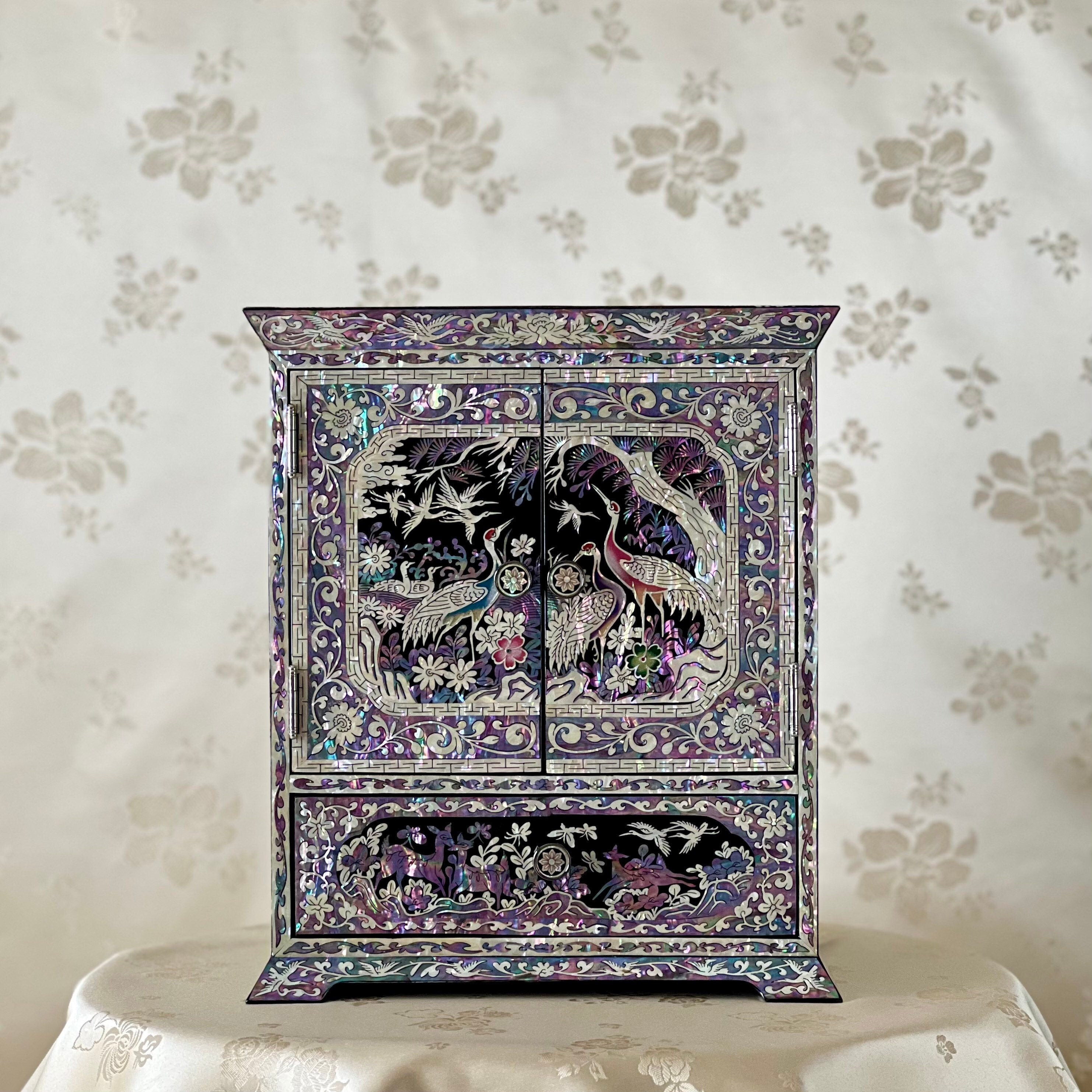
Najeonchilgi (나전칠기) — lacquerware inlaid with mother-of-pearl — is one of Korea's most storied traditional art forms. It dates back over a thousand years, reaching the height of its sophistication during the Goryeo dynasty (918–1392), when Korean craftsmen were celebrated across East Asia for the extraordinary delicacy of their work.
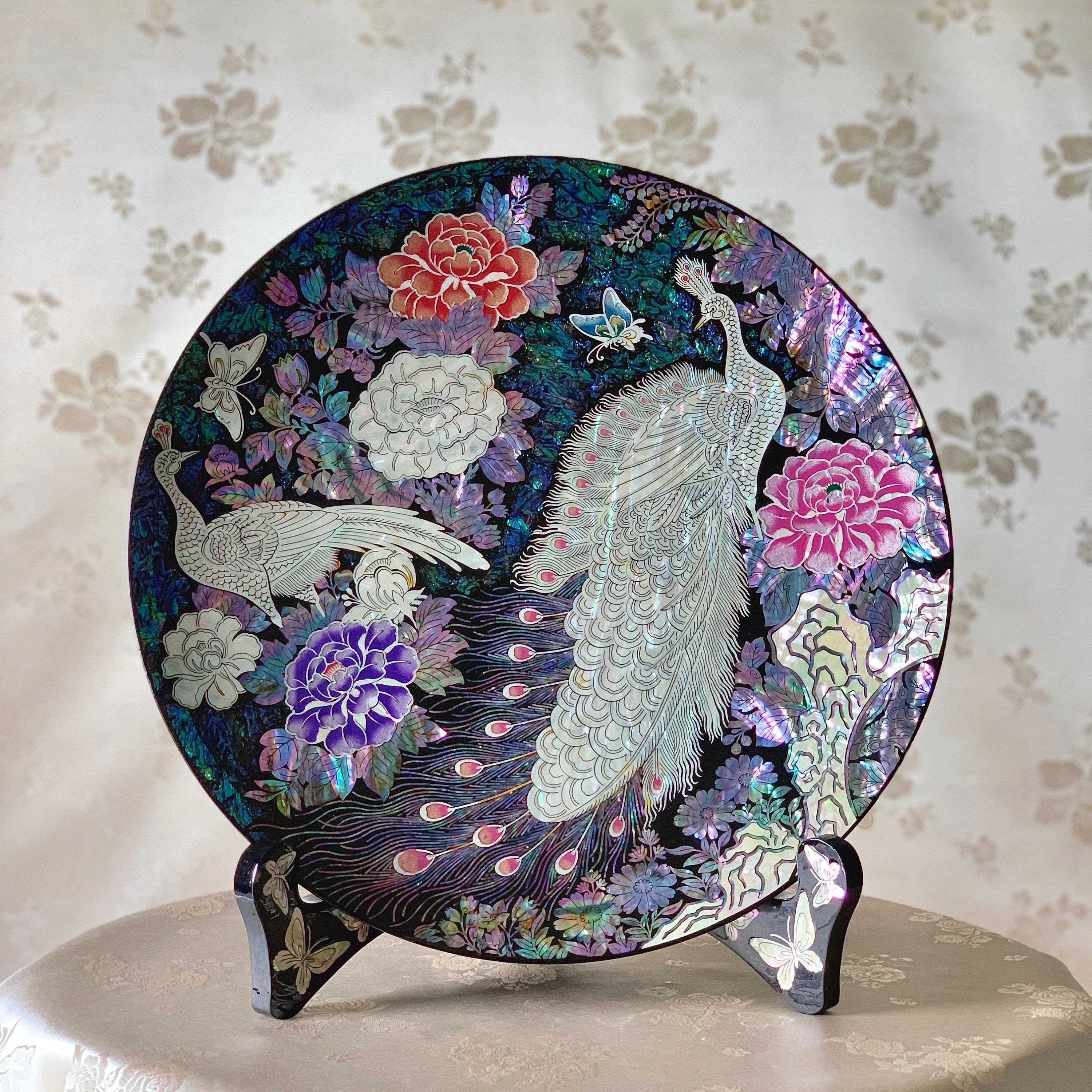
The process is staggeringly labour-intensive. Thin pieces of abalone or other shells are cut, filed, and arranged into intricate patterns — flowers, cranes, phoenixes, cloud scrolls, geometric latticework — then inlaid into a wooden base and sealed under layers of traditional lacquer (ottchil). A single wardrobe or chest can take a year or more to complete. The result is an object that seems to hold light inside itself, shifting from green to blue to gold depending on the angle.
"This should be one of the representative traditional craftworks of Korea as it takes a lot of work from processing the shells to final lacquering."
Lee Young-ok describes mother-of-pearl and pearl as fundamentally the same material, just formed differently: "Mother-of-pearl is formed on the inner linings of a shell, while a pearl is formed around an intruder. Mother-of-pearl, or nacre, is the design a shell bears on its body — and it has infinite possibilities."
THE INNOVATION
When She Dared to Add Color
Traditional najeonchilgi uses the natural iridescence of the shell — and for most practitioners, that was enough. It was always enough. The shimmer of nacre has captivated artists for a millennium. But Lee Young-ok, with her engineering instinct and restless curiosity, asked a question no one else had seriously pursued: what if you could add color to mother-of-pearl without losing its luminosity?
The answer, it turned out, was yes — but the road was rocky. "At first, other craftsmen disapproved," she recalled, "being sarcastic about adding colors onto originally gorgeous natural mother-of-pearl." The tradition was so deeply revered that any deviation felt like a betrayal.

The innovation wasn't just aesthetic. It was strategic. By enabling color, Jinjooshell could produce smaller, more affordable goods — hand mirrors, card cases, phone cases — that brought najeonchilgi within reach of everyday life, not just collectors and luxury buyers. It was a quiet revolution.
RECOGNITION
A Master, Officially
Korea takes its living craft heritage seriously, and its official recognition systems reflect that. Lee Young-ok holds one of the country's highest craft designations: Traditional Craftsmaster, Designation No. 67 (전예제 16–명67호). The title is not honorary — it is earned through documented mastery, peer review, and a body of work that advances the tradition.

In April 2021, she was named a Daehangmin Myeongin (대한민국 명인) — a Distinguished Person of Korea — at a ceremony held at Seoul City Hall. The award recognised not just her technical skill but her decades of creative contribution and her efforts to bring the craft to new audiences.
She has won the Grand Prix Award at the Korea Traditional Masters Exhibition, been featured in Vogue Korea, and collaborated with some of the most recognisable brands on the planet — Samsung, Starbucks, Sulwhasoo, Aston Martin, and Hyundai Handsome, among others. In 2025, her patented colored mother-of-pearl boxes were selected as official gifts for the MAMA Awards in Hong Kong, placing her work on one of the biggest stages in Asian popular culture.
ON SCREEN & IN LIFE
The Craft That Became Famous Without Trying
One of the most charming chapters in Lee Young-ok's story is how her work found its way into Korean cinema and television without her having to do anything but make beautiful things. Her lacquerware and furniture have appeared in major productions including Assassination (2015), The Princess and the Matchmaker (2018), 100 Days My Prince (2018), and — perhaps most famously in Korea — SKY Castle (2018), the drama that became a national phenomenon.
"One of the mother-of-pearl screens featured on SKY Castle was sold after airing. I am grateful when people become interested in our lacquerware through media exposure."
It's a testament to the power of her work that audiences watching these dramas didn't just notice the furniture — they wanted it. The screen became a gallery. The gallery became a shop. And the craft, for a new generation of Koreans, became desirable again.
✦
THE FUTURE
A New Tradition in the Making
Lee Young-ok is candid about the challenges facing her craft. "Among the mother-of-pearl artisans, I am one of the youngest even though I'm in my 60s," she has said. The ageing of the artisan community is a quiet crisis across many of Korea's traditional crafts, and najeonchilgi is no exception.
Her solution is characteristically forward-thinking. Jinjooshell runs hands-on mother-of-pearl workshops at their Bukchon Hanok Village showroom in central Seoul — a space designed not to sell products but to let people feel the craft, touch the shells, understand the process. Her two children have joined the business, keeping the three-generation lineage alive.

Her philosophy — 온고지신 (溫故知新), "learning the old to understand the new" — shapes everything Jinjooshell does. It's not about abandoning tradition. It's about trusting that tradition is strong enough to absorb innovation without breaking. That the iridescent light inside a piece of abalone shell is so extraordinary that it doesn't need protection — it needs partnership.
Lee Young-ok has spent her life being that partner.